





What's Happening?
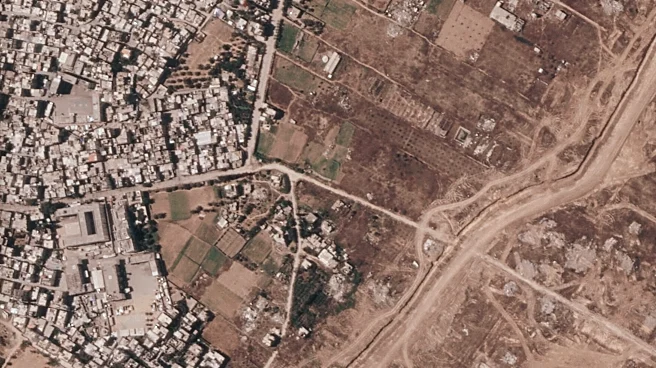
The Israel Defense Forces (IDF) have constructed a significant earthen barrier stretching over 23 kilometers across the Gaza Strip, as revealed by satellite images from Planet Labs PBC. This barrier separates IDF-controlled areas from regions where the majority
of Gaza's Palestinian population resides. The IDF confirmed the barrier's existence, stating it is part of a security zone around the Yellow Line, intended to prevent terrorist crossings and protect Israeli communities and troops. The construction has rapidly expanded, particularly near Rafah, with the barrier extending from the Rafah area toward al-Mawasi, where displaced Palestinians have set up tent camps. The IDF maintains that this project does not establish a new border, although some sections appear to extend beyond the Yellow Line.
Why It's Important?
The construction of this barrier has significant implications for the region's geopolitical landscape. It raises concerns about the potential for a permanent division of Gaza, which could further complicate peace efforts and humanitarian conditions. The barrier's expansion may affect the movement of people and goods, exacerbating the already challenging living conditions for Palestinians in Gaza. Additionally, the barrier's presence could influence future negotiations and the broader Israeli-Palestinian conflict, as it may be perceived as a unilateral move by Israel to solidify control over certain areas. The international community, including organizations focused on peace and human rights, may view this development with concern, potentially impacting diplomatic relations and aid efforts.
What's Next?
If construction continues at the current pace, the barrier could eventually connect with other segments, creating a more extensive division across Gaza. This development may prompt reactions from Palestinian authorities, international organizations, and neighboring countries, potentially leading to increased tensions or calls for intervention. The IDF's ongoing operations and the barrier's expansion could also influence the dynamics of ceasefire agreements and future peace talks. Monitoring the situation will be crucial for stakeholders involved in the region's stability and humanitarian efforts.