



What's Happening?
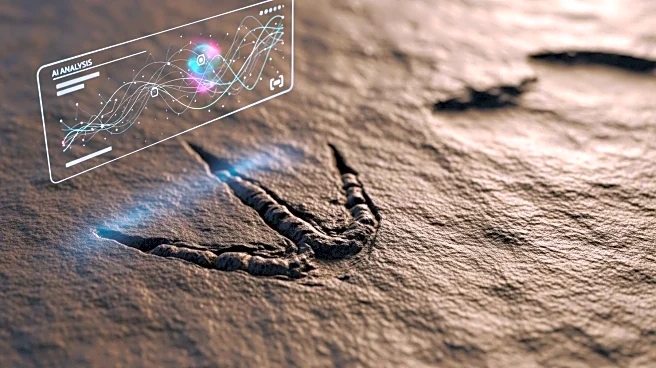
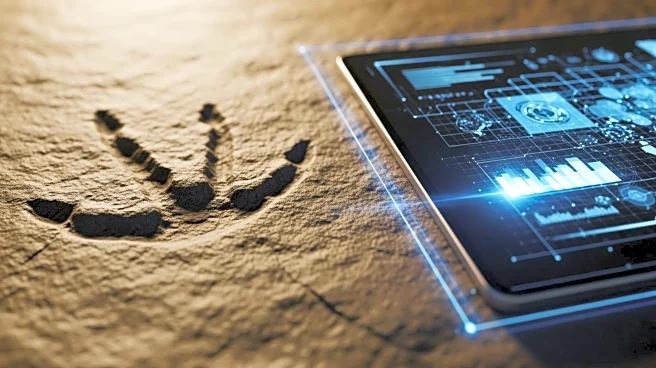
An international research collaboration has developed an artificial intelligence tool named Dinotracker, designed to accurately identify dinosaur footprints. This innovation aims to improve the precision of paleontological studies by moving beyond traditional
subjective interpretations of ancient trackways. The project is a joint effort between Germany's Helmholtz-Zentrum research center and the University of Edinburgh. Their findings, published in the Proceedings of the National Academy of Sciences, represent a significant advancement in prehistoric research. The AI system analyzes eight critical characteristics of dinosaur footprints, such as toe width and heel position, to deduce the most probable dinosaur responsible for a given track. During testing, Dinotracker aligned with human expert classifications in 90% of cases, demonstrating its reliability.
Why It's Important?
The development of Dinotracker marks a significant step forward in paleontology, offering a more objective method for analyzing fossilized footprints. This tool could potentially reshape our understanding of dinosaur species and their evolutionary history. By providing a consistent and unbiased analysis, Dinotracker helps mitigate the human element of interpretation, which can lead to varying conclusions. The AI's ability to identify morphological similarities between ancient tracks and modern birds could prompt a reevaluation of the timeline for bird evolution. This advancement not only enhances scientific accuracy but also opens new avenues for research in the field of paleontology.
What's Next?
Dinotracker is now available to the scientific community via GitHub, allowing researchers worldwide to utilize this tool in their studies. While freely accessible, its implementation requires some familiarity with software development. The AI's findings, particularly regarding the evolutionary timeline of birds, may lead to further investigations and discussions within the scientific community. As researchers continue to explore the capabilities of Dinotracker, it could become a standard tool in paleontological research, potentially leading to new discoveries and insights into the history of life on Earth.
Beyond the Headlines
The introduction of AI in paleontology highlights the growing intersection between technology and traditional sciences. Dinotracker's development underscores the potential for AI to transform fields that rely heavily on expert interpretation. This tool not only enhances the accuracy of paleontological research but also demonstrates the broader applicability of AI in scientific disciplines. As AI continues to evolve, its role in research and analysis is likely to expand, offering new opportunities for innovation and discovery across various fields.