







What's Happening?
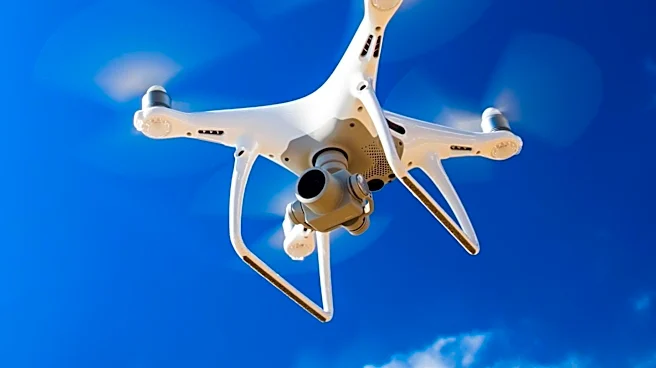
Researchers at the Massachusetts Institute of Technology (MIT) have developed a new autonomous navigation system for uncrewed aerial vehicles (UAVs) called SANDO (Safe AutoNomous trajectory planning for Dynamic unknOwn environments). This system is designed
to ensure UAVs can navigate safely and avoid collisions in environments where obstacles are moving and the terrain is unfamiliar. Unlike previous systems that either handle static environments or loosely avoid dynamic obstacles without formal safety guarantees, SANDO provides a mathematical assurance that the UAV will not crash. The system works by mapping out a time-sensitive safety corridor, which accounts for the possible future movements of dynamic obstacles by calculating their maximum potential velocity. This allows the UAV to continuously adjust its flight path to remain collision-free. The research, led by Kota Kondo, a recent PhD graduate in aeronautics and astronautics at MIT, has been published in the IEEE Transactions on Robotics. SANDO has been tested in simulations, where it outperformed other state-of-the-art systems in speed and collision avoidance, and in 12 real-world test flights, successfully avoiding all dynamic obstacles.
Why It's Important?
The development of SANDO is crucial for enhancing the safety and effectiveness of UAV operations in high-stakes, unpredictable environments. Current UAV navigation systems often lack the ability to guarantee collision avoidance in dynamic, unknown settings, limiting their deployment in critical applications. SANDO's formal safety guarantees mean that UAVs can be reliably used in dangerous scenarios such as search and rescue missions in collapsed buildings, exploration of hidden mine tunnels, or even package delivery in crowded urban areas. This technology could significantly reduce the risk to human rescuers by allowing drones to gather vital information in hazardous conditions, such as raging wildfires with falling debris. The ability to operate autonomously and safely in complex environments also opens up new possibilities for commercial applications, potentially streamlining logistics and improving efficiency in various industries. The mathematical rigor behind SANDO's design ensures its reliability, which is a key factor for widespread adoption in sensitive operations where failure is not an option.
What's Next?
Looking ahead, the MIT researchers aim to further enhance SANDO's computational efficiency. This improvement would allow for even faster recalculations of trajectories, enabling UAVs to react more swiftly to sudden environmental changes. Additionally, there are plans to integrate SANDO with machine-learning models. This integration would enable users to provide instructions to the UAVs using natural language, making the system more intuitive and accessible. Such advancements could simplify the operation of these complex machines, broadening their potential user base and applications. The ongoing research is partly funded by the Defense Science and Technology Agency of Singapore, indicating potential future applications in defense and security sectors. The continued development and refinement of SANDO could lead to its deployment in a wider range of real-world scenarios, from disaster response to commercial logistics, ultimately making autonomous flight safer and more versatile.
Beyond the Headlines
The innovation behind SANDO extends beyond mere technological advancement; it addresses fundamental challenges in autonomous systems' interaction with unpredictable real-world environments. The concept of a 'time-sensitive safety corridor' and the rigorous mathematical proof of collision avoidance represent a significant leap in robotic autonomy. This approach could influence the design of other autonomous vehicles, including self-driving cars and underwater drones, by providing a robust framework for guaranteed safety in dynamic settings. Ethically, the reliability of SANDO could reduce human exposure to danger in rescue operations, but it also raises questions about the increasing reliance on autonomous systems in critical decision-making. The ability of a machine to make life-or-death navigation decisions without human intervention, even with mathematical guarantees, will likely spark broader discussions about accountability and control in autonomous technology. Furthermore, the system's ability to operate without a pre-existing map highlights a shift towards more adaptive and intelligent robotic systems, capable of learning and responding to their surroundings in real-time, rather than relying solely on pre-programmed data.