


What's Happening?
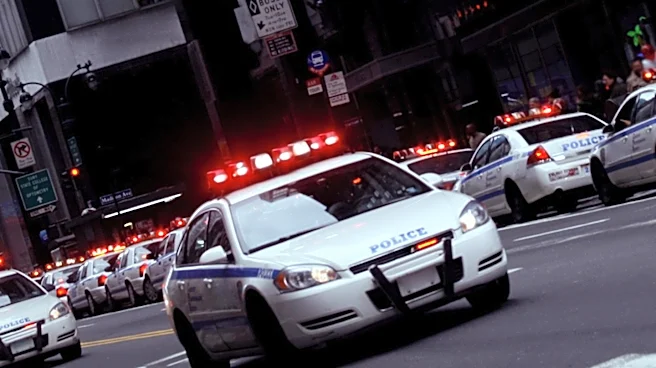
The Vancouver Police Department (VPD) and firefighters forcibly entered the Access Gallery after a 911 caller reported seeing what they believed were human feet sticking out from behind a counter, indicating a person in distress. The gallery director,
Saghi Ehteshamzadeh, was contacted by police late Friday night, who informed her of a potential intruder. Despite her initial alarm and assurances that the gallery was secured with an alarm, police proceeded to breach the door when they couldn't establish contact with the gallery. Upon entry, authorities discovered that the perceived human was, in fact, a sculpture titled 'The Preparator' by Alyssa Pierre. The artwork depicts an art preparator kneeling with their upper body seemingly disappearing into a crate, leading to the misunderstanding. The incident resulted in approximately $1,000 in damages to the gallery for replacing the lock and gate.
Why It's Important?
This incident highlights several critical issues, including the potential for misidentification in emergency situations and the financial burden placed on small cultural institutions due to such errors. For the Access Gallery, a non-profit organization, the unexpected cost of nearly $1,000 for repairs is significant and could impact its operational budget. It also raises questions about the protocols followed by emergency services when responding to calls, particularly regarding verification of information before resorting to forced entry. The gallery director noted that a simple Google search could have clarified the nature of the artwork, suggesting a need for improved information-gathering procedures in non-immediate threat scenarios. The event also inadvertently draws attention to the often 'unnoticed' labor of art preparators, the subject of the sculpture, by making their work the center of an unexpected public incident.
What's Next?
The Access Gallery has filed a claim with the City of Vancouver to seek compensation for the damages incurred during the incident and is awaiting a response. To prevent similar misunderstandings in the future, the gallery plans to cover the sculpture at night. The artwork, 'The Preparator,' is part of the ongoing 'PENDING' exhibition, and the gallery is using this unexpected attention to invite the public to visit and see the piece. The gallery is also actively working to raise funds for its 35th anniversary, and this event may inadvertently contribute to increased public awareness and visitation. The incident may also prompt a review of emergency response protocols in situations involving potential misidentification of objects, especially in public spaces like art galleries.
Beyond the Headlines
Beyond the immediate financial and procedural implications, this event touches upon broader themes of perception, interpretation, and the role of art in public spaces. The sculpture, designed to highlight the often-overlooked work of art preparators, ironically gained significant attention due to its misinterpretation. This incident could spark discussions within the art community and among emergency services about how to prevent such occurrences, perhaps through better public information or clearer signage for installations that might be ambiguous. It also underscores the challenge of distinguishing between reality and artistic representation, especially in a fast-paced emergency response environment. The gallery director's comment about resources being spent on 'non-emergencies' while real needs go unmet points to a larger societal concern about resource allocation and the efficiency of public services.