







What's Happening?
Ukrainian defense companies are actively integrating artificial intelligence into their missile systems, marking a significant advancement in the country's defense capabilities. This initiative, supported by Brave1, Ukraine's defense innovation platform,
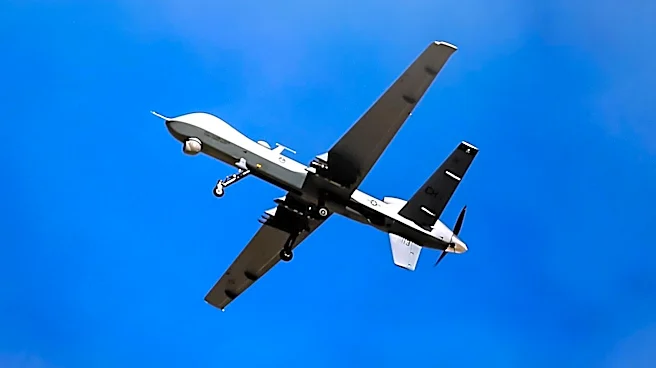
is still in its early stages but is showing initial progress. While AI has been extensively used in unmanned aerial vehicles (UAVs) and ground-based robotic systems for navigation, target guidance, and decision-making, its application in missile systems presents greater technical challenges due to the higher speeds required. Andrii Hrytseniuk, CEO of Brave1, noted that while the scale of AI integration in missiles has not yet reached that of drones, numerous developments are underway. This move aligns with Ukraine's broader strategy of investing in long-range strike capabilities and reducing troop exposure by utilizing unmanned systems for high-risk missions like casualty evacuation and logistics. Ukraine has also leveraged AI to significantly reduce the time spent on target identification from battlefield imagery, and Ukrainian companies will have access to Avengers Labs, an AI training platform with a dataset of approximately 5 million annotated war images.
Why It's Important?
The integration of AI into missile systems represents a critical leap in Ukraine's defense modernization efforts, potentially enhancing the precision, autonomy, and effectiveness of its long-range strike capabilities. This development could shift the balance of power on the battlefield by enabling more sophisticated targeting and decision-making processes, reducing reliance on human operators in high-stress environments. For the U.S. and its allies, Ukraine's advancements in AI-enabled defense systems offer valuable insights into modern warfare strategies and the rapid adaptation of technology in conflict zones. It underscores the growing importance of AI in military doctrine globally and could influence future defense collaborations and technology transfers. Furthermore, by reducing the need for human presence in dangerous operations, Ukraine aims to minimize casualties, which has significant implications for troop morale and operational sustainability. The use of extensive battlefield imagery for AI training also highlights a new paradigm in military intelligence and technological development, where real-world data drives rapid innovation.
What's Next?
The ongoing development of AI-enabled missile systems in Ukraine suggests a continued push towards more autonomous and technologically advanced defense capabilities. Future efforts will likely focus on overcoming the technical hurdles associated with high-speed AI processing for missiles and scaling up production. Ukraine may seek further international partnerships and technological assistance to accelerate these developments, potentially leading to increased collaboration with U.S. and European defense industries. The success of these AI integrations could also influence other nations to adopt similar strategies, fostering a global trend towards AI-driven military modernization. Additionally, as these systems become more sophisticated, there will be an increased focus on testing, validation, and ethical guidelines to ensure their reliable and responsible deployment. The continuous feedback loop from battlefield data to AI training platforms like Avengers Labs will likely lead to rapid iterations and improvements in these systems.
Beyond the Headlines
The shift towards AI-enabled missile systems in Ukraine signifies a broader transformation in military strategy, moving from traditional hardware-centric defense to software-defined deterrence. This approach emphasizes rapid innovation, data-driven decision-making, and the integration of advanced algorithms to gain a tactical advantage. The extensive use of battlefield imagery to train AI models raises questions about data privacy, the ethics of AI in warfare, and the potential for algorithmic bias in targeting. Moreover, the drive to replace soldiers with unmanned systems in dangerous roles reflects a growing global trend to minimize human risk in conflict, which could reshape military recruitment, training, and operational doctrines. This technological evolution also highlights the increasing importance of a robust domestic defense innovation ecosystem, as exemplified by Brave1, which can rapidly translate technological concepts into deployable solutions. The long-term implications include a potential redefinition of military power, where technological prowess in AI and autonomous systems becomes as crucial as, if not more than, traditional military might.