
What's Happening?
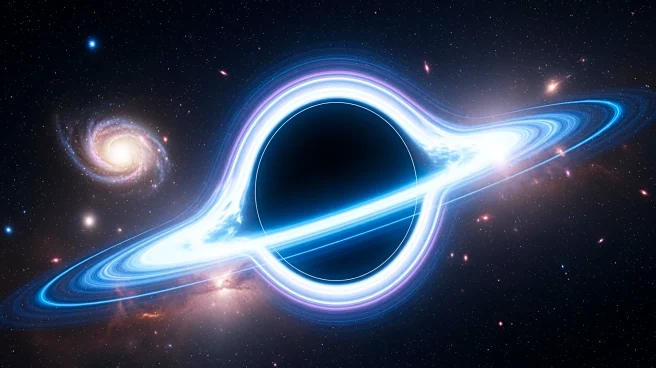
The year 2025 has seen significant advancements in black hole research, driven by observations from the James Webb Space Telescope (JWST) and other observatories. Notable discoveries include a rapidly
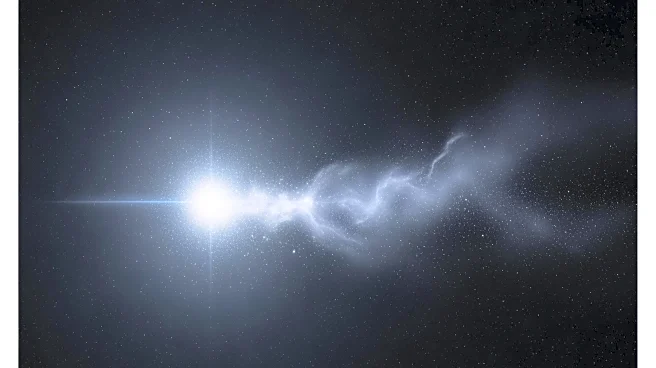
growing supermassive black hole in a galaxy formed shortly after the Big Bang, and a runaway supermassive black hole moving at extraordinary speeds. These findings challenge existing models of galaxy and black hole formation, offering new insights into cosmic processes. Additionally, observations of cosmic tornadoes and mid-infrared flares around Sagittarius A star have provided valuable data on the behavior of quiet black holes.
Why It's Important?
These breakthroughs are crucial for understanding the role of black holes in galaxy evolution and the dynamics of the early Universe. The discovery of rapidly growing black holes in young galaxies challenges current theories and suggests that black holes have been influential since the Universe's earliest epochs. Observations of runaway black holes and cosmic tornadoes offer new perspectives on the forces shaping galaxies and the distribution of matter. These findings have the potential to refine models of cosmic evolution and inform future research in astrophysics.
What's Next?
Continued observations by JWST and other telescopes are expected to yield further discoveries, enhancing our understanding of black holes and their impact on the Universe. As technology advances, astronomers anticipate more frequent detection of interstellar objects and black holes, which will contribute to a more comprehensive understanding of cosmic phenomena. Future research will likely focus on the implications of these discoveries for galaxy formation theories and the development of new models to explain the behavior of black holes.