
What's Happening?
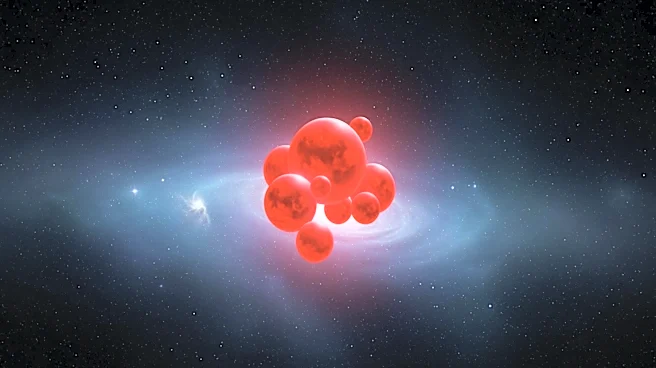
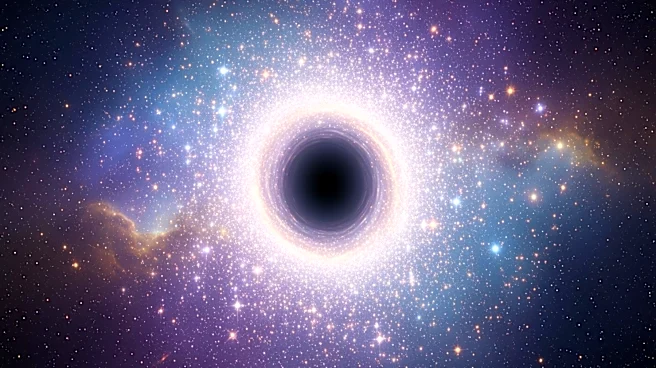
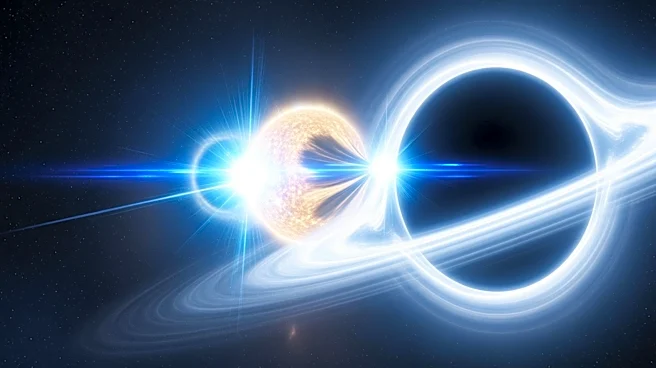
Recent research proposes that Luminous Fast Blue Optical Transients (LFBOTs), rare and powerful cosmic explosions, may be caused by black holes or neutron stars colliding with Wolf-Rayet stars. These events,
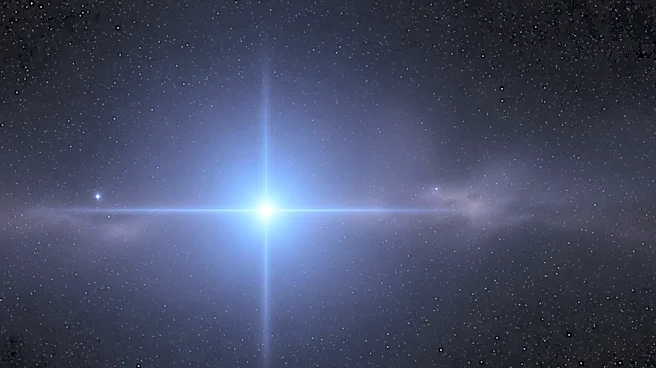
first observed in 2018, are characterized by their rapid evolution and persistent blue color, indicating high temperatures. The study suggests that these explosions occur when a compact stellar remnant merges with a massive star's helium core, stripped of its hydrogen envelope. This model aligns with the observed properties of LFBOTs, differing from other proposed origins like supernovas or tidal disruption events.
Why It's Important?
Understanding the origins of LFBOTs is crucial for astrophysics, as these events provide insights into stellar evolution and the dynamics of binary star systems. The proposed model highlights the unique environments and conditions necessary for these explosions, offering a new perspective on cosmic phenomena. This research could lead to advancements in our understanding of stellar remnants and their interactions, impacting theories on galaxy formation and the lifecycle of stars.
What's Next?
The research team plans to further investigate LFBOTs by expanding the known population of these events. The Vera C. Rubin Observatory's Legacy Survey of Space and Time is expected to play a significant role in discovering more LFBOTs, allowing scientists to study their properties and origins in greater detail. This could lead to a more comprehensive understanding of these rare cosmic events and their implications for astrophysics.