






What's Happening?
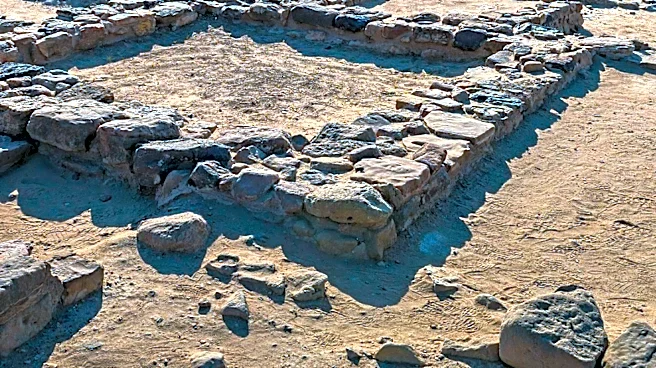
Andriy Krasnozhon, a Ph.D. in History and archaeologist, has presented findings from excavations on Primorsky Boulevard in Odesa that challenge the long-held belief that Catherine II founded the city from scratch. The archaeological evidence, including
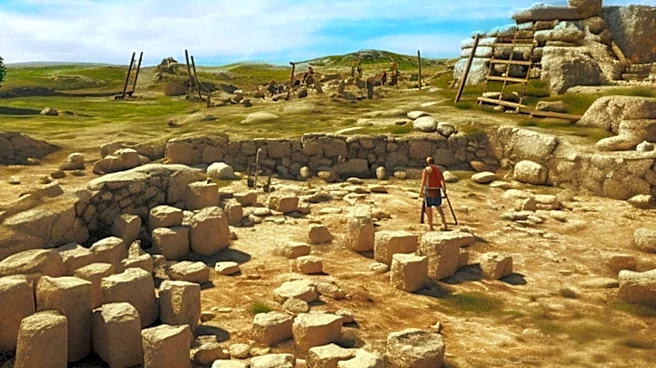
architectural remains from various eras, indicates a continuous history of human activity at the site. Discoveries range from ancient Greek settlements to Ottoman-era fortifications, specifically the Khadzhibey Castle, and cultural layers from the medieval Italian trading post of Genestra. Krasnozhon emphasizes that the main discovery is not just the structures themselves, but their archaeological context, which provides scientific evidence for dating and understanding the site's history. For instance, the Ottoman fortification was identified through structural features of its substructure and associated finds like 18th-century flintlock musket flints and flattened lead bullets, indicating a siege. The stones used in the Ottoman castle were found to be repurposed from an ancient Greek settlement, Istrian Harbor, further demonstrating the site's layered history. These findings suggest that Odesa has a much older and more complex past than previously attributed to Catherine II's era.
Why It's Important?
These archaeological discoveries are important because they fundamentally reframe the historical narrative of Odesa, a significant port city. By debunking the myth of Catherine II as the sole founder, the research highlights the city's deep historical roots, connecting it to ancient Greek, medieval Italian, and Ottoman periods. This revised understanding underscores Odesa's continuous role as a transportation hub and its inherent connection to the broader Black Sea region's economic and geographical logic. The findings emphasize that Odesa's existence and function are intrinsically linked to Ukraine's economy, particularly its role in grain export to the Mediterranean. This perspective challenges narratives that might seek to diminish Odesa's Ukrainian identity by asserting a more recent, external origin. The continuous repurposing of building materials across different eras, from ancient Greek structures to Ottoman castles and later Russian barracks, illustrates a persistent pattern of settlement and strategic importance, driven by the region's geographical advantages for trade and resource supply. This historical depth reinforces Odesa's enduring significance as a gateway for Ukrainian resources to the Eastern Mediterranean.
What's Next?
The ongoing archaeological research is expected to continue uncovering more layers of Odesa's past, potentially revealing further evidence that will solidify the revised historical understanding. Future excavations will likely focus on expanding the current findings, particularly in areas that could shed more light on the 15th-century presence, which currently lacks archaeological confirmation. The scientific community will continue to analyze and interpret these discoveries, potentially leading to new academic publications and revised historical texts. Public engagement and educational initiatives will be crucial to disseminate these findings, ensuring that the broader public understands Odesa's multifaceted history. This could involve museum exhibitions, documentaries, and educational programs that highlight the city's ancient and medieval heritage. The re-evaluation of Odesa's founding narrative may also influence cultural and political discourse, reinforcing the city's historical ties to Ukraine and the broader Black Sea region, and potentially impacting how its identity is perceived both domestically and internationally.
Beyond the Headlines
The re-evaluation of Odesa's founding narrative carries deeper implications beyond historical accuracy. It challenges nationalistic interpretations that often simplify or appropriate historical origins for political purposes. By demonstrating a continuous urban culture and economic function spanning millennia, the research underscores Odesa's organic development as a vital port, driven by geographical imperatives rather than a singular founding event. This perspective highlights the fluidity of historical ownership and cultural influence in the Black Sea region, where various empires and peoples have left their mark. The continuous repurposing of building materials, from ancient Greek stones to Ottoman fortifications and later Russian structures, symbolizes a cyclical pattern of human activity and adaptation, where each era built upon the remnants of the last. This deeper understanding can foster a more nuanced appreciation of Odesa's identity, recognizing it as a product of diverse historical currents rather than a creation of a single power. It also reinforces the idea that cities, especially those with strategic geographical locations, often have complex, layered histories that defy simplistic narratives.