







What's Happening?
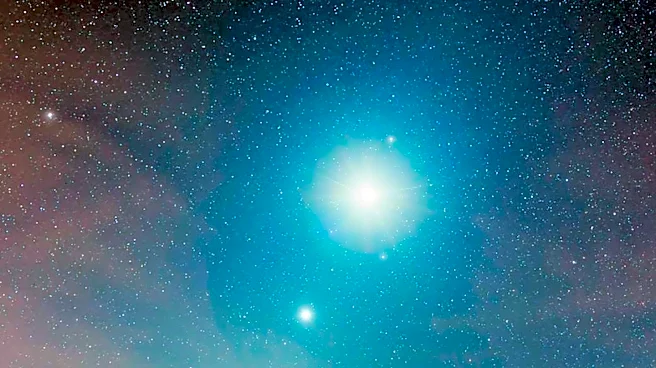
On the evening of July 24, 2026, skywatchers can observe a celestial event as the Moon passes close to the bright red giant star Antares, the heart of the Scorpius constellation. The conjunction will be visible in the southern sky after sunset, with the Moon appearing
just to the lower left of Antares. This event provides a striking visual as the waxing gibbous Moon, illuminated at 82%, aligns with the ruby-red star, which is often compared to Mars due to its similar hue and brightness. The entire Scorpius constellation, along with nearby constellations such as Sagittarius and Boötes, will be visible, offering a rich tapestry of stars for observers.
Why It's Important?
Celestial events like the Moon's conjunction with Antares offer opportunities for both amateur and professional astronomers to engage with the night sky. Such events can inspire interest in astronomy and provide educational opportunities to learn about constellations and celestial navigation. The visibility of the Scorpius constellation and its neighboring constellations during this event allows observers to explore the structure and mythology of these star patterns. Additionally, observing the Moon's movement relative to the stars can enhance understanding of celestial mechanics and the dynamics of our solar system.