



What's Happening?
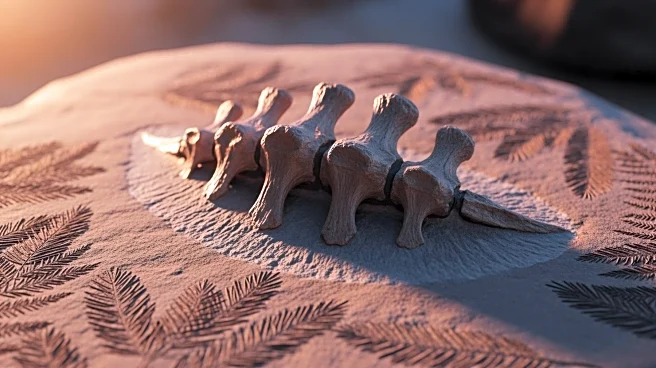
A new species of dinosaur, Mamenchisaurus sanjiangensis, has been discovered in southwest China, offering new insights into Jurassic ecosystems. This long-necked sauropod, identified by paleontologist Hui Dai and his team, lived approximately 160 million
years ago. The discovery was made in the Upper Shaximiao Formation near Chongqing, where bones were found in mudstones near a shallow lake. The species is characterized by its enormous size and long neck, features that allowed it to browse over wide areas without moving extensively. The bones' camellate structure, with air-filled chambers, suggests a balance between size and agility. This find contributes to understanding the diversity and distribution of sauropods in East Asia during the Jurassic period.
Why It's Important?
The discovery of Mamenchisaurus sanjiangensis is crucial for understanding the evolution and ecological roles of sauropods in Jurassic East Asia. It challenges previous notions of geographic isolation in the region, suggesting that dinosaur lineages were more widespread than previously thought. The species' anatomical features provide insights into how these massive creatures supported their weight and adapted to their environments. This find also fills gaps in the fossil record, offering a clearer picture of sauropod diversity and evolution during a critical period in Earth's history.
What's Next?
Future research will likely focus on further excavations and detailed analysis of the Mamenchisaurus sanjiangensis fossils to refine its classification and understand its ecological role. Comparative studies with other sauropod fossils from the region may reveal more about the evolutionary pathways and interactions of these dinosaurs. High-resolution scans and biomechanical modeling could provide deeper insights into the structural adaptations that allowed these dinosaurs to thrive.