



What's Happening?
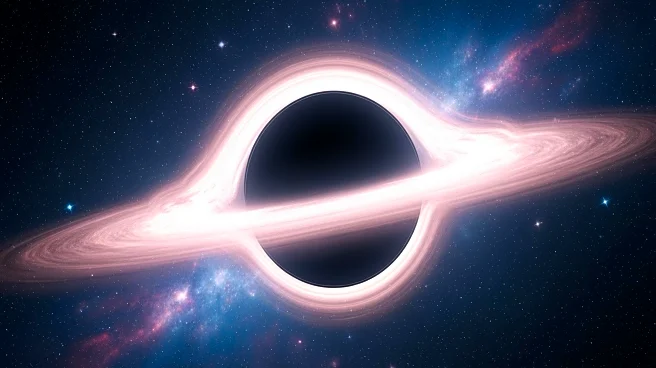
The James Webb Space Telescope (JWST) has provided new insights into the formation of the universe's first supermassive black holes. Theoretical astrophysicist Priyamvada Natarajan from Yale University discussed these findings at the World Economic Forum.
Her research suggests that under specific primordial conditions, massive black holes could form directly from collapsing gas clouds, bypassing the traditional star formation process. This theory helps explain the existence of supermassive black holes in the early universe, which conventional models struggle to account for. Observations from JWST and other telescopes have begun to validate these predictions, revealing early black holes with masses millions of times that of the sun.
Why It's Important?
Understanding the formation of supermassive black holes is crucial for comprehending the evolution of galaxies and the universe. These findings challenge existing models and offer a new perspective on cosmic history. The research highlights the role of black holes in shaping galaxies and influencing modern technology, such as GPS systems. The ability to detect and study these early black holes provides valuable data that can refine our understanding of the universe's structure and the forces that govern it.
Beyond the Headlines
The study of black holes not only advances scientific knowledge but also carries philosophical implications. It encourages a sense of cosmic humility and a deeper appreciation of humanity's place in the universe. The research underscores the interconnectedness of scientific discovery and technological advancement, as the same principles that explain black holes also underpin technologies like GPS. This dual impact of black hole research on both science and society exemplifies the broader significance of astrophysical studies.