







What's Happening?
The field of RNA therapeutics is on the cusp of significant acceleration, driven by recent advancements in artificial intelligence, according to Rhiju Das, PhD, a professor of biochemistry at Stanford Medicine. This follows the U.S. Food and Drug Administration's
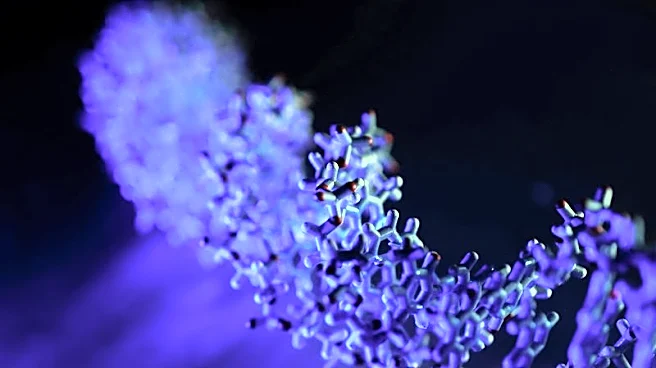
approval of the first-ever mRNA flu vaccine for adults aged 50 and above in August. Dr. Das notes that while AI-designed small molecule drugs and proteins are already in clinical trials, RNA therapeutics are approximately five years away from similar milestones. His work, including the community science platform Eterna, has shown that AI algorithms can now design RNA molecules as effectively as experienced human participants, leading to the creation of novel, atomically ordered 3D RNA shapes. These AI-generated designs, visualized through cryo-electron microscopy, exhibit intricate interactions previously thought to require billions of years of evolution.
Why It's Important?
The integration of AI into RNA therapeutics holds immense potential to transform medicine. The ability to design highly stable and complex RNA structures could lead to a new generation of drugs with enhanced capabilities, such as sensing specific cell types, computing molecular signals, and precisely controlling treatment activation. This could result in more effective and targeted therapies for a wide range of diseases, including cancer and infectious diseases. The current need for RNA vaccines to be kept frozen, which complicates shipping and distribution, could be overcome by AI-designed stable RNA molecules with longer shelf lives. This would significantly improve accessibility and global health equity, particularly in regions with limited cold-chain infrastructure. The acceleration of RNA design through AI could also drastically reduce development timelines for new treatments, offering quicker responses to emerging health crises.
What's Next?
Over the next few years, the focus will be on solving foundational design problems in RNA therapeutics. Dr. Das anticipates that community science platforms like Eterna, combined with ongoing AI research, will generate seminal proofs of concept that will establish a new ecosystem for RNA design. This will attract further investment and momentum, similar to what has been observed in AI-designed small molecule drugs and proteins since 2021-2022. The development of AI-designed RNA drugs will require continued collaboration between AI researchers, biochemists, and pharmaceutical companies to translate these breakthroughs into clinical applications. The goal is to create RNA therapeutics that are not only highly effective but also stable and easily deployable, marking a new era in personalized and precision medicine.
Beyond the Headlines
The emergence of AI-designed RNA molecules with novel 3D shapes opens up profound possibilities beyond current therapeutic applications. These sophisticated structures could enable RNA to perform complex functions, acting as molecular computers within cells. This could lead to 'smart' drugs that can adapt their behavior based on the cellular environment, offering unprecedented control over biological processes. The ethical implications of such advanced molecular engineering will also become increasingly relevant, particularly concerning the potential for unintended biological interactions or long-term effects. Furthermore, the democratization of RNA design through platforms like Eterna suggests a future where scientific discovery is more collaborative and accessible, potentially accelerating innovation by leveraging collective intelligence alongside advanced AI capabilities.