
What's Happening?
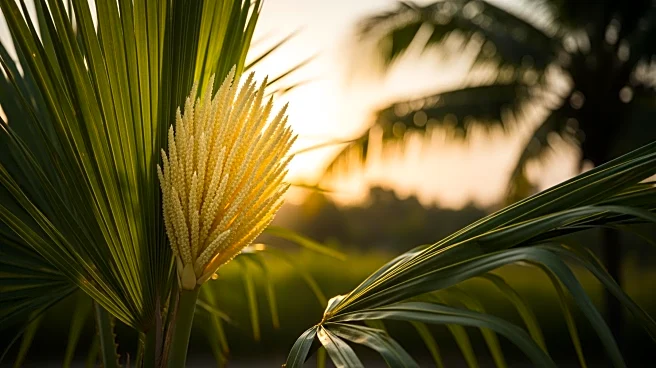
In Rio de Janeiro, Brazil, a group of talipot palm trees has bloomed for the first and only time after being planted in the 1960s by landscape architect Roberto Burle Marx. These palms, originating from
southern India and Sri Lanka, are known for their unique lifecycle, blooming once at the end of their 40 to 80-year lifespan. The spectacle, featuring a large plume with millions of tiny flowers, has attracted attention in Flamengo Park and Rio's Botanical Garden. The blooming event has sparked interest in environmental conservation among locals.
Why It's Important?
The blooming of these rare palm trees serves as a reminder of the importance of biodiversity and environmental conservation. It highlights the role of botanical gardens and parks in preserving rare species and educating the public about ecological issues. The event has also inspired efforts to collect and plant seedlings for future generations, emphasizing the need for sustainable practices in urban planning and landscape architecture. This rare natural occurrence underscores the interconnectedness of global ecosystems and the impact of human activity on biodiversity.