



What's Happening?
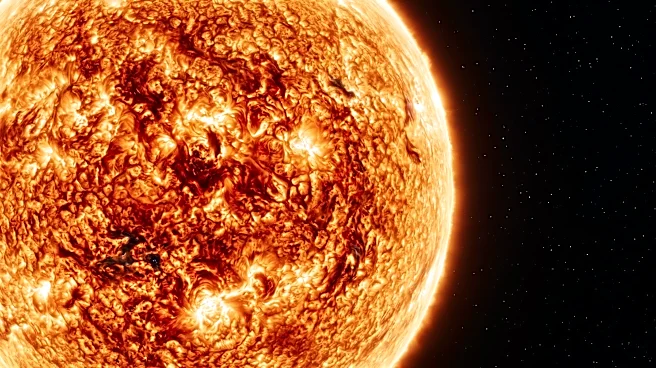
New modeling research suggests that faculae, which are bright regions on the Sun's visible surface, appear dark on cooler stars, such as M-dwarfs. This finding, presented by Alexander Shapiro and collaborators, complicates the interpretation of exoplanet
transmission spectra. Astronomers typically assume that faculae on other stars behave similarly to those on the Sun, appearing as bright spots. However, simulations using three-dimensional radiative magnetohydrodynamics and radiative transfer modeling for stars of spectral types G2 (Sun-like), K2, M0, and M4, show a transition. While faculae on G2 stars are bright, they become fainter on K2 and M0 stars, and critically, appear darker than the surrounding stellar surface on M4 stars. This unexpected behavior is attributed to competing factors related to magnetic fields and gas pressure within the faculae.
Why It's Important?
The appearance of dark faculae on cooler stars has significant implications for exoplanet research, particularly in the analysis of exoplanet atmospheres. Transmission spectroscopy, a key method for studying exoplanet atmospheres, relies on accurately understanding the host star's properties. If faculae are incorrectly assumed to be bright on cooler stars, it can lead to misinterpretations of exoplanet transmission spectra. Specifically, dark faculae can artificially increase the derived radius of an exoplanet, while bright faculae decrease it. This 'contamination' is wavelength-dependent and can mimic spectral features that might otherwise be attributed to atmospheric components, potentially leading to erroneous conclusions about the presence of certain gases or the overall composition of an exoplanet's atmosphere. This necessitates a re-evaluation of existing exoplanet data and a more nuanced approach to future observations.
What's Next?
Astronomers will need to incorporate these new findings into their models for analyzing exoplanet transmission spectra, especially for exoplanets orbiting cooler M-dwarf stars. This will involve developing more sophisticated stellar models that account for the varying appearance of faculae across different stellar types. Future observational campaigns will likely focus on obtaining more detailed data on the surfaces of M-dwarf stars to validate these simulation results. The refinement of these models will be crucial for accurately characterizing exoplanet atmospheres and identifying potential biosignatures. This research will also guide the design of next-generation telescopes and observational techniques to minimize the impact of stellar activity on exoplanet characterization, ensuring more reliable and accurate atmospheric analyses.
Beyond the Headlines
This discovery highlights the intricate complexities involved in studying exoplanets and the subtle ways in which stellar phenomena can influence our interpretations. It underscores the importance of 'knowing thy star' to truly 'know thy planet.' The transition of faculae from bright to dark across different stellar temperatures reveals a deeper physical understanding of stellar magnetic activity and its interaction with stellar atmospheres. This ongoing refinement of astronomical models is a testament to the scientific process, where new observations and theoretical insights continuously challenge and improve our understanding of the universe. Ultimately, a more accurate characterization of exoplanet atmospheres brings us closer to answering fundamental questions about the prevalence of life and the diversity of planetary environments beyond our solar system.