







What's Happening?
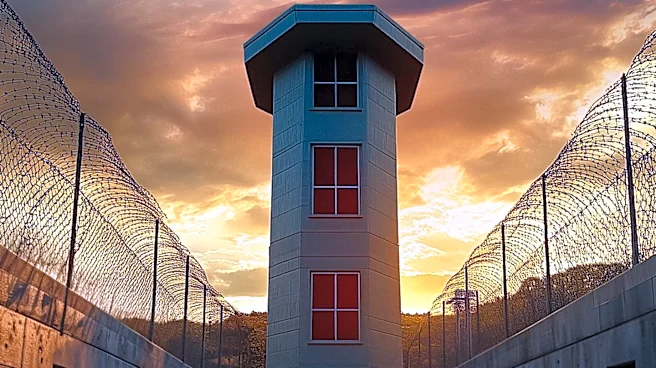
Former Mexican President Enrique Peña Nieto has publicly addressed the 2015 escape of Joaquín 'El Chapo' Guzmán from the Altiplano maximum-security prison in the docuseries 'Operación Cisne Negro.' Peña Nieto described the event as a significant political
blow to his administration, using the colloquial phrase, 'Even the best hunter lets the hare get away.' He recounted being in Europe when he received news of the escape and initially disbelieving it. 'El Chapo' escaped through a 1.5-kilometer tunnel dug beneath his cell. The escape, which took months to plan and seconds to execute, led to a six-month manhunt before Guzmán's recapture in January 2016 in Los Mochis, Sinaloa. The docuseries aims to reconstruct the events surrounding the escape and subsequent recapture, placing Peña Nieto's perspective at the center of the narrative.
Why It's Important?
The 2015 escape of 'El Chapo' Guzmán from a maximum-security prison was a major international incident that significantly impacted U.S.-Mexico relations and perceptions of Mexico's ability to combat organized crime. For the U.S., 'El Chapo' represented a primary target in the war on drugs, and his escape raised concerns about the security of Mexican institutions and the potential for continued drug trafficking into American communities. Peña Nieto's reflection in the docuseries offers a rare glimpse into the high-level political fallout and the challenges faced by a head of state during such a crisis. The incident underscored the sophistication and reach of drug cartels, demonstrating their capacity to undermine state authority and security measures, which has direct implications for U.S. border security and anti-narcotics efforts. The recapture was a significant win for both nations, but the escape itself highlighted vulnerabilities that continue to be relevant in ongoing security cooperation.
What's Next?
The docuseries 'Operación Cisne Negro,' set to premiere on ViX in 2026, will provide a detailed account of 'El Chapo's' escape and recapture, offering new perspectives from key figures like former President Peña Nieto. The release of the docuseries could reignite public discussion and scrutiny regarding the security protocols of Mexican prisons and the broader issue of corruption within the justice system. For the U.S., understanding the intricacies of such high-profile escapes can inform future strategies for international cooperation in combating drug cartels and ensuring the secure detention of high-value targets. The narrative presented in the docuseries may also influence public opinion on the effectiveness of past and present anti-crime policies in Mexico and their implications for U.S. national security interests.
Beyond the Headlines
Peña Nieto's use of the phrase 'Even the best hunter lets the hare get away' is more than a colloquialism; it reflects a broader sentiment about the inherent difficulties in confronting powerful criminal organizations. This statement, coming from a former president, can be interpreted as an acknowledgment of the immense challenges faced by governments in controlling the drug trade, even with significant resources. The escape itself exposed not only security lapses but also the potential for deep-seated corruption that can facilitate such elaborate operations. The docuseries, by bringing these events back into public discourse, could prompt a re-evaluation of the ethical and practical dimensions of state power versus organized crime. It also highlights the enduring fascination with figures like 'El Chapo' and the narratives surrounding their criminal exploits, which often become part of popular culture, influencing public perception and policy debates.