






What's Happening?
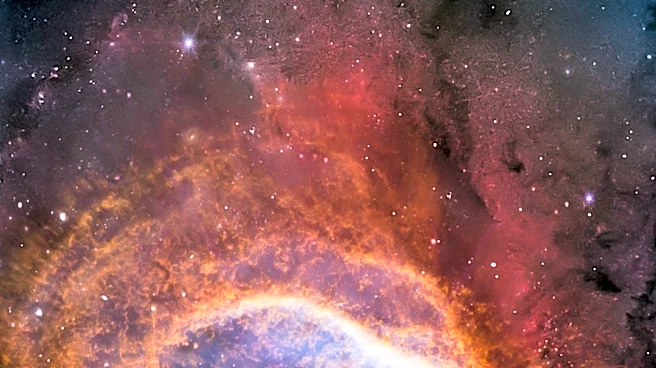
Astrophotographer Kevin Boardman has captured a highly detailed image of the Crescent Nebula, also known as NGC 6888 or Caldwell 27. The nebula, located approximately 4,700 light-years from Earth in the constellation Cygnus, is a 25-light-year-wide bubble
formed from stellar material ejected by the colossal Wolf-Rayet star WR 136 (HD 192163). Boardman's image reveals intricate filaments of gas surrounding this massive star, which is nearing the end of its life and is expected to explode as a supernova in about 100,000 years. He achieved this detailed view by collecting over 16 hours of data across five nights in late July, utilizing narrowband filters to isolate specific wavelengths of light emitted by ionized gases, such as orange-red H-alpha and blue-cyan [O III].
Why It's Important?
This astrophotography achievement provides valuable insights into the life cycle of massive stars and the complex processes that shape nebulae. The detailed imagery of the Crescent Nebula helps scientists and enthusiasts visualize the turbulent environment created by Wolf-Rayet stars, which are rare and play a significant role in enriching the interstellar medium with heavy elements. Understanding these stellar phenomena contributes to our broader knowledge of galactic evolution and the origins of elements essential for life. The use of narrowband filters to highlight different gas compositions offers a clearer picture of the nebula's structure and dynamics, enhancing scientific analysis and public appreciation of cosmic wonders.
What's Next?
The detailed image of the Crescent Nebula will likely be used for educational purposes and further scientific study, potentially inspiring new research into Wolf-Rayet stars and their surrounding nebulae. Astrophotographers will continue to refine techniques and equipment to capture even more intricate details of celestial objects. The public's engagement with such images fosters a greater appreciation for astronomy and encourages interest in space science. Future observations, possibly with more advanced telescopes or imaging techniques, could provide even deeper insights into the evolution of the Crescent Nebula and the eventual supernova of WR 136.
Beyond the Headlines
The capture of such a stunning image goes beyond mere scientific documentation; it represents a fusion of art and science. Astrophotography, as demonstrated by Boardman's work, transforms complex astronomical data into visually compelling narratives that can be understood and appreciated by a wider audience. It highlights the accessibility of advanced astronomical observation to dedicated individuals, not just large institutions. The image also serves as a poignant reminder of the immense scales of time and space in the universe, with the star WR 136's impending supernova being a cosmic event that will unfold over millennia. This blend of scientific rigor and aesthetic beauty inspires wonder and curiosity about the universe, fostering a deeper connection between humanity and the cosmos.