



What's Happening?
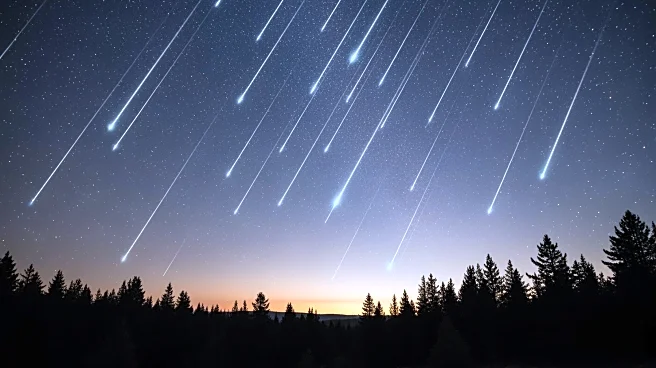
The Quadrantid meteor shower, one of the most dramatic yet brief meteor showers of the year, is set to light up the night sky this week. At its peak, the shower can produce up to 100 meteors per hour, a spectacle that few other annual showers can match.
However, this year, the visibility of the meteors may be compromised by a full moon, which could overshadow the event. The Quadrantids are named after Quadrans Muralis, a now-defunct constellation, and originate from asteroid 2003 EH1, a 'rock comet' discovered by astronomer Peter Jenniskens. This asteroid behaves like a comet that has lost its spark, and some researchers believe it could be the remains of comet C/1490 Y1, observed over China in 1490.
Why It's Important?
The Quadrantid meteor shower offers a unique opportunity for skywatchers to witness a celestial event that is both spectacular and elusive. The shower's peak lasts only a few hours, making it a rare occurrence that requires precise timing to observe. Despite the full moon potentially hindering visibility, experienced observers know that fireballs, larger meteors that can briefly outshine the moon, can still be seen. This event highlights the importance of understanding celestial phenomena and their origins, as well as the historical significance of such events, which have captivated humans for centuries.
What's Next?
Observers hoping to catch the Quadrantid meteor shower are advised to find remote, dark locations away from city lights and allow their eyes at least 30 minutes to adjust to the darkness. The use of telescopes or binoculars is discouraged, as meteors are best seen with the naked eye across a wide field of view. Despite the full moon, the potential for seeing fireballs makes it worth attempting to view the shower. This event serves as a reminder of the unpredictable nature of skywatching and the need for patience and preparation.
Beyond the Headlines
The Quadrantid meteor shower not only provides a visual spectacle but also serves as a reminder of the interconnectedness of historical and astronomical events. The potential link between asteroid 2003 EH1 and comet C/1490 Y1 underscores the importance of studying celestial bodies and their trajectories. This connection offers insights into the long-term evolution of comets and asteroids, contributing to our understanding of the solar system's history and dynamics.