
What's Happening?
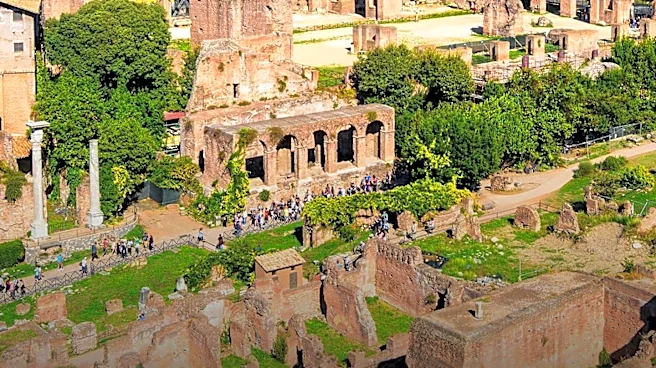
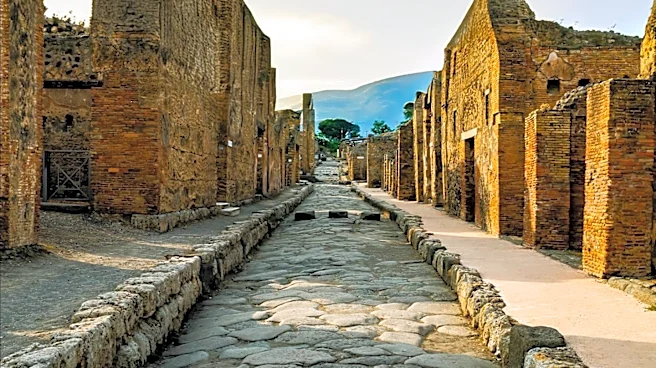
Recent archaeological findings in the Insula Meridionalis, located in the southern area of ancient Pompeii, are challenging the long-held belief that the city was completely abandoned after the AD 79 eruption of Vesuvius. Materials and ceramic artifacts
dating from the 15th and 16th centuries have provided fresh evidence of human presence at the site centuries before the official Bourbon excavations began in 1748. This discovery suggests that while the Roman city lay buried, people continued to live among its ruins and maintain its memory. Gabriel Zuchtriegel, director of the Archaeological Park of Pompeii, notes that this nuanced story, termed 'Pompeii after Pompeii,' highlights the persistence of local communities who returned to and utilized the area, albeit in a fragile and unofficial capacity. These traces of precarious lives, previously overlooked, indicate that Pompeii was not entirely erased from collective memory.
Why It's Important?
This re-evaluation of Pompeii's post-eruption history significantly impacts our understanding of historical continuity and human resilience. It shifts the narrative from a city 'reborn' in the 18th century to one that maintained a continuous, albeit understated, presence in the local community's life and imagination. The discovery underscores the importance of examining historical sites for less obvious signs of human activity, moving beyond grand narratives to uncover the stories of ordinary people. For archaeologists and historians, it opens new avenues of research into the periods between major historical events, suggesting that even catastrophic destruction does not always lead to complete abandonment. This perspective enriches the cultural heritage of Pompeii, presenting it not just as a preserved Roman city, but as a place with a complex, multi-layered history that continued to evolve for centuries.
What's Next?
The Archaeological Park of Pompeii is actively working to integrate these new findings into its research and outreach initiatives. Visitors can now tour the Insula Meridionalis excavation site, with reservations available from Monday to Friday between 11:00 and 12:00. This direct engagement with the ongoing archaeological work allows the public to witness the unfolding of this revised historical narrative. Further research will likely focus on uncovering more evidence of these post-eruption communities and understanding their daily lives, social structures, and how they interacted with the buried city. The park aims to continue piecing together the story of 'Pompeii after Pompeii,' potentially leading to new exhibitions, publications, and educational programs that reflect this expanded historical understanding.
Beyond the Headlines
The revelation that Pompeii was not entirely forgotten but rather inhabited and remembered for centuries after its destruction carries profound implications for how we perceive historical sites and the concept of heritage. It highlights the enduring human connection to place, even in the face of immense tragedy and environmental change. The persistence of the place name 'Civita' (city) in local memory, as noted by Zuchtriegel, suggests a deep-seated cultural memory that transcends formal historical records or archaeological recognition. This challenges the notion that a site's significance is solely defined by its peak historical period or its rediscovery by modern archaeology. Instead, it emphasizes the continuous, often informal, ways in which communities preserve and interact with their past, suggesting a more organic and fluid relationship between people and their historical landscapes.