




What's Happening?
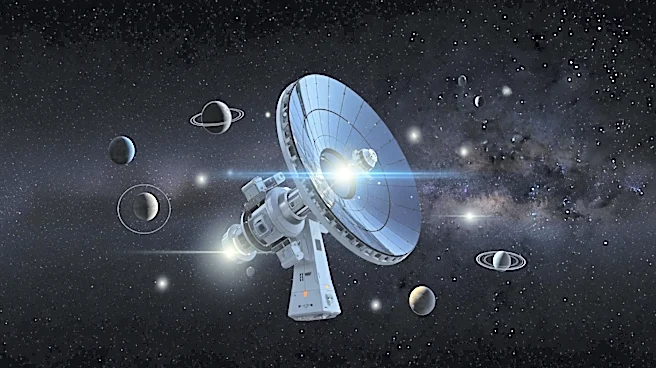
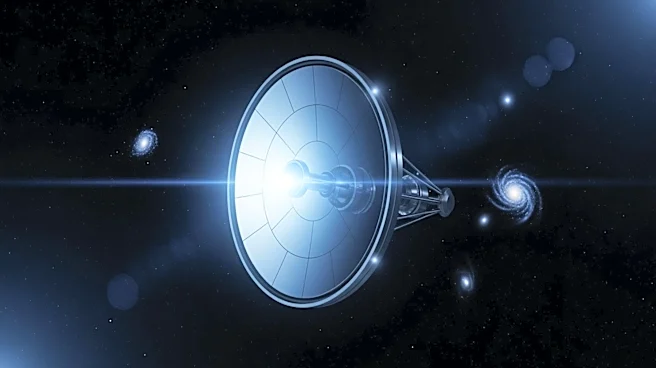
NASA's Nancy Grace Roman Space Telescope is preparing to significantly expand the search for exoplanets, potentially identifying around 100,000 new worlds. This mission aims to explore underexplored regions of the Milky Way, extending beyond the local
neighborhood of our solar system. The Roman Telescope will employ two primary methods: the transit method, which is effective in detecting large, hot planets, and microlensing, which can identify planets with larger orbits, including those similar to Earth and Mars. This dual approach will allow scientists to study a wide variety of planetary systems, providing insights into planet formation across different galactic environments.
Why It's Important?
The Roman mission's ability to discover a vast number of exoplanets will enhance our understanding of planetary systems and their formation. By exploring diverse regions of the Milky Way, the mission could reveal how common planetary systems like our own are, and how they differ across the galaxy. This data is crucial for understanding the potential for life elsewhere in the universe and could inform future missions aimed at studying exoplanet atmospheres in more detail. The mission's findings will also be publicly available, allowing for widespread scientific collaboration and discovery.
What's Next?
As the Roman mission prepares for launch, scientists are developing software and simulations to handle the expected influx of data. The mission will provide a foundational dataset that could revolutionize our understanding of exoplanets, similar to the impact of the Kepler mission. Future studies may focus on the atmospheres of the discovered planets, using the Roman data to identify targets for more detailed analysis by telescopes like the James Webb Space Telescope.