



What's Happening?
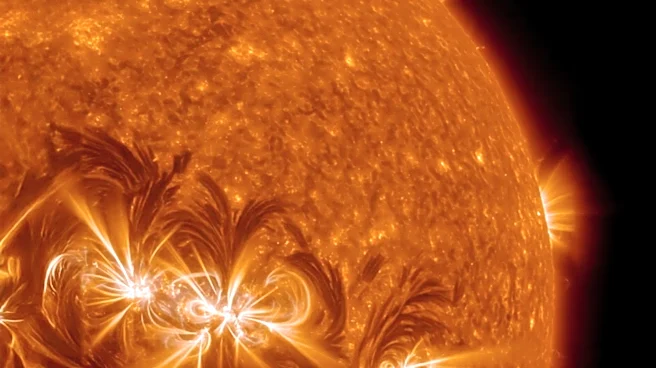
The European Space Agency (ESA) is set to launch a CubeSat named HENON in early 2027, aiming to significantly improve the early warning system for solar storms. This mission will place the CubeSat ten times farther from Earth than current solar storm sentinels,
equipped with a UK-built magnetometer to detect coronal mass ejections. The HENON mission is designed to extend the warning time for geomagnetic storms from the current 15 minutes to nearly three hours, providing critical lead time for power grid operators, satellite controllers, and airline dispatchers. The CubeSat will be launched as a secondary payload on the Ariane 6 rocket and will maneuver into its operational orbit using a miniaturized ion thruster.
Why It's Important?
The extended warning time provided by the HENON mission is crucial for mitigating the impacts of solar storms on critical infrastructure. Power grid managers have long stated that the current 15-minute warning is insufficient for taking protective actions such as isolating transformers and rerouting power flows. The additional lead time could prevent significant economic losses, as severe geomagnetic disturbances have the potential to cause cascading transformer failures and economic damage exceeding $1 trillion. The mission also represents a technological advancement in space weather forecasting, potentially paving the way for future operational missions.
What's Next?
Following its launch, HENON will take approximately 14 months to reach its operational orbit. The mission will serve as a technology demonstration, with the potential to lead to a follow-on concept called SHIELD, which would deploy multiple CubeSats for continuous coverage. The success of HENON could influence future space weather forecasting strategies and infrastructure protection measures.