



What's Happening?
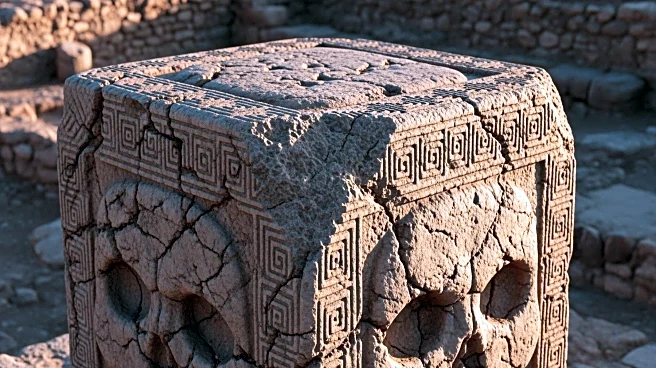
A cube-shaped skull discovered in the Balcón de Montezuma archaeological zone in Tamaulipas, Mexico, is providing new insights into the social practices of a 1,400-year-old Mesoamerican civilization. The skull, belonging to a man who died around the age
of 40 between 400 and 900 AD, exhibits a unique form of artificial cranial deformation. According to Mexico’s National Institute of Anthropology and History, this type of skull modification was not uncommon among Mesoamerican societies, where it often signified elevated social status or deep spirituality. The skull's shape, described as 'parallelepiped' by biological anthropologist Jesús Ernesto Velasco González, deviates from the more common 'cone-head' shapes previously found in the region. This discovery suggests that the man’s culture practiced a distinct form of cranial modification, although the exact cultural significance remains unknown.
Why It's Important?
The discovery of the cube-shaped skull is significant as it adds to the understanding of cultural diversity and social practices among ancient Mesoamerican civilizations. Such findings can provide insights into the social hierarchies and spiritual beliefs of these societies. The practice of cranial deformation, as seen in this skull, highlights the importance of physical appearance in social stratification and cultural identity. This discovery also underscores the complexity of Mesoamerican civilizations, which included diverse groups such as the Olmec, Chichimec, and Huastec tribes. Understanding these practices can help anthropologists and historians piece together the cultural and social dynamics of ancient societies in the region.
What's Next?
Further research and analysis of the skull and other archaeological findings in the region could provide more detailed insights into the specific cultural practices and societal structures of the civilization to which the man belonged. Scientists may conduct additional tests on the skull's bones and teeth to gather more information about the individual's life and the broader cultural context. This discovery may also prompt new archaeological explorations in Tamaulipas and surrounding areas to uncover more artifacts that could shed light on the interactions between different Mesoamerican cultures.
Beyond the Headlines
The practice of cranial deformation, as evidenced by this discovery, raises questions about the ethical implications of body modification in ancient societies. It also invites comparisons with modern practices of body modification and the cultural significance attached to physical appearance. Additionally, the discovery highlights the importance of preserving archaeological sites and artifacts, as they provide invaluable insights into human history and cultural evolution.