




What's Happening?
Russia's space program is experiencing significant delays, with the launches of three spacecraft—Luna-28, Luna-29, and Luna-30—postponed. The Russian Academy of Sciences announced these delays, with Luna-29 now scheduled for 2032, Luna-28 for 2036, and Luna-30 for 2034.
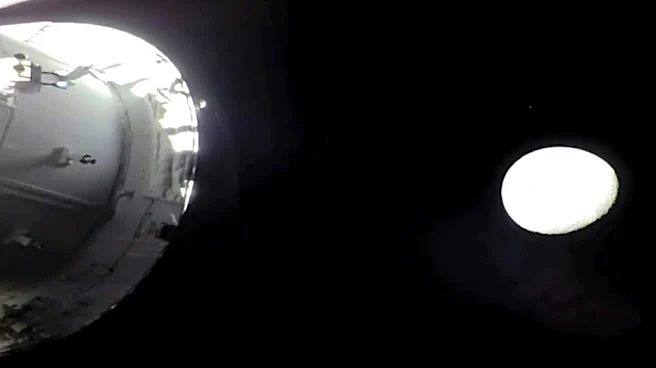
This announcement comes as NASA's Artemis II mission successfully sent astronauts deeper into space than ever before. The delays in Russia's space program follow a series of setbacks, including the failed Luna-25 mission in 2023. The Russian space agency, Roscosmos, has not provided reasons for the postponements. Meanwhile, Artemis II marks a significant milestone for NASA, as it is the first crewed flight beyond low Earth orbit in over 50 years, aiming to return humans to the lunar surface.
Why It's Important?
The delays in Russia's space program highlight ongoing challenges within the country's aerospace sector, which has struggled since the Soviet Union's collapse. These setbacks could impact Russia's ability to compete in the global space race, particularly as the U.S. and other nations make significant advancements. The success of NASA's Artemis II mission underscores the U.S.'s leadership in space exploration, potentially influencing international collaborations and investments in space technology. The Artemis program aims to establish a sustainable human presence on the moon, which could have far-reaching implications for scientific research and commercial opportunities.