


What's Happening?
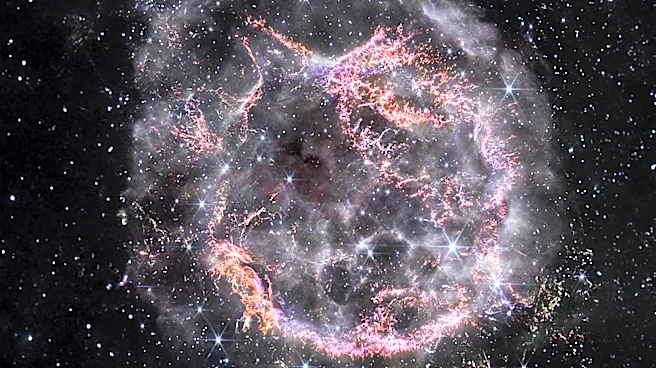
Astronomers have observed a rare supernova event, providing new insights into the death of massive stars. The event, detected by the Einstein Probe, involved a faint burst of X-rays from a galaxy 500 million light-years away, leading to the discovery
of supernova SN 2026gzf. This supernova, classified as a Type Ic-BL, did not exhibit the expected gamma-ray burst, suggesting a new pathway for massive star deaths. The findings were made possible through coordinated observations by several NSF NOIRLab facilities and international partners.
Why It's Important?
This discovery challenges existing theories about the end-of-life stages of massive stars and the conditions that lead to gamma-ray bursts. By revealing a new type of supernova event, the findings could significantly impact our understanding of stellar evolution and the mechanisms behind cosmic explosions. The research also demonstrates the power of collaborative, multi-wavelength astronomy in capturing transient cosmic events, paving the way for future discoveries in the field.