
What's Happening?
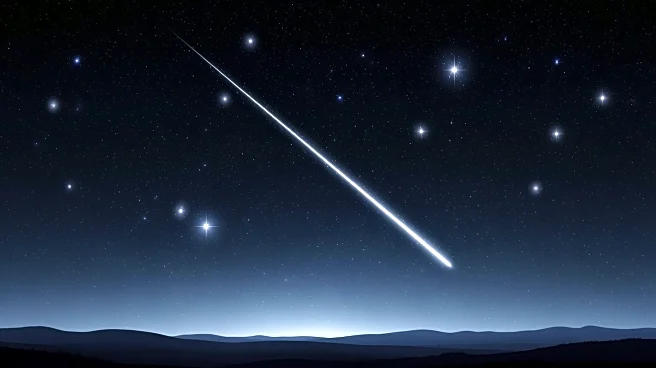
Astronomy Magazine provides a detailed overview of celestial events occurring from January 2 to January 9, 2026. The period begins with a 'Super Moon' on January 2-3, coinciding with the peak of the Quadrantid
meteor shower and Earth's perihelion. Observers are encouraged to view notable targets such as the bi-colored double star Eta Cassiopeiae, the Winter Hexagon asterism, and Comet 24P/Schaumasse near globular clusters M53 and NGC 5053. Key planetary events include Venus reaching superior conjunction on January 6 and Mars at conjunction with the Sun on January 9, making both planets unobservable during these times. Jupiter offers a transit of its moon Europa and its shadow across its disk on January 7, while diminished moonlight later in the week allows for observation of the Perseus Cluster of galaxies and the Hercules Cluster (M13).
Why It's Important?
These celestial events provide opportunities for both amateur and professional astronomers to observe and study various astronomical phenomena. The Quadrantid meteor shower, despite interference from the Super Moon, is known for producing bright fireballs, offering a spectacle for sky watchers. The conjunctions of Venus and Mars highlight the dynamic nature of planetary movements and their visibility from Earth. Jupiter's moon transits offer insights into the planet's satellite dynamics and atmospheric conditions. Such events can inspire public interest in astronomy and contribute to scientific research, enhancing our understanding of the universe.
What's Next?
As the week progresses, observers can look forward to clearer skies for viewing fainter celestial objects, particularly after the Moon rises late in the evening. The Perseus Cluster of galaxies and the Hercules Cluster will be more accessible for observation. Additionally, the upcoming opposition of Jupiter will provide further opportunities to study its moons and atmospheric features. Astronomers and enthusiasts will continue to track these events, potentially capturing images and data that contribute to ongoing research and public engagement in astronomy.
Beyond the Headlines
The events described not only offer visual spectacles but also serve as reminders of the intricate and interconnected nature of celestial mechanics. The study of these phenomena can lead to advancements in astrophysics, such as understanding gravitational interactions and the lifecycle of stars and galaxies. Moreover, public interest in such events can foster educational initiatives and inspire future generations to pursue careers in science and technology, contributing to a broader appreciation of the natural world.