





What's Happening?
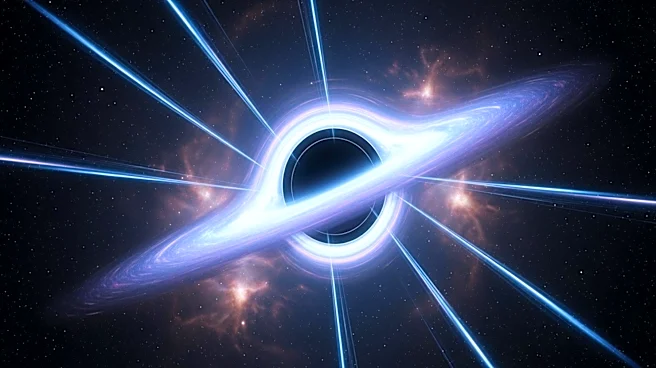
Scientists have, for the first time, measured the instantaneous power and speed of jets emitted from a black hole in the Cygnus X-1 system. This system, located 7,200 light-years away in the Milky Way's Cygnus constellation, features a black hole and a blue
supergiant star. The research, led by Steve Prabu from the University of Oxford, utilized 18 years of high-resolution radio imaging. The findings reveal that the jet power is equivalent to 10,000 suns, with speeds reaching half the speed of light. This study marks a significant advancement in understanding the energy dynamics of black holes, as previous measurements averaged jet power over thousands of years.
Why It's Important?
The ability to measure the power and speed of black hole jets in real-time provides critical insights into the role black holes play in shaping galaxies and cosmic structures. The discovery that 10% of the energy released as matter falls into the black hole is carried away by these jets could influence future astronomical research and theories about galaxy formation. This advancement in measurement techniques may lead to a deeper understanding of the universe's fundamental processes, potentially impacting fields such as astrophysics and cosmology.
What's Next?
The research team plans to apply their measurement techniques to other black holes, which could further enhance our understanding of these cosmic phenomena. This ongoing research may lead to new discoveries about the behavior of black holes and their influence on the universe. As scientists continue to explore these jets, they may uncover more about the interactions between black holes and their surrounding environments.