
What's Happening?
The Congressional Budget Office (CBO) has released a report indicating that President Trump’s tariffs are temporarily mitigating the federal deficits caused by the Republican tax and spending law. The law,
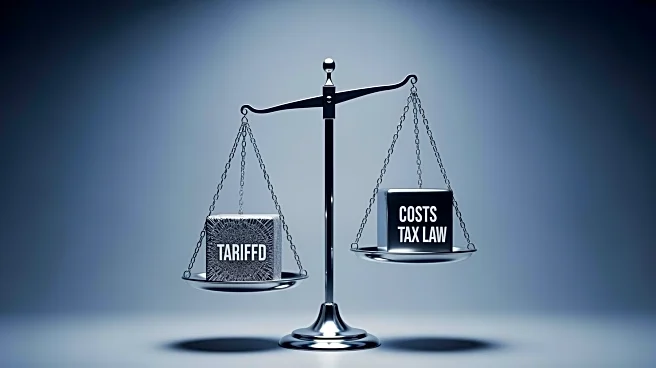
known as the One Big Beautiful Bill, introduced significant income tax cuts, increased the standard deduction, and implemented new business tax cuts, while also boosting defense and immigration enforcement spending. These measures are projected to increase federal deficits by $4.7 trillion over the next decade. However, the tariffs imposed by the Trump administration on imports have reduced projected deficits by $3 trillion. Despite this, the CBO warns that tariffs will lead to higher inflation and could hinder economic growth by increasing the cost of imported goods and reducing foreign investment. The report also forecasts that U.S. debt will rise from 101% of GDP to over 120% by 2036, potentially leading to higher borrowing costs and a financial crisis.
Why It's Important?
The CBO's findings underscore the complex interplay between tax policy and trade measures in shaping the U.S. economy. While the tariffs provide short-term relief to the federal deficit, they also pose long-term risks by potentially stifling economic growth and increasing inflation. The growing national debt, exacerbated by the GOP tax law, could lead to higher interest rates and undermine confidence in the U.S. dollar. This situation presents a significant challenge for policymakers who must balance fiscal responsibility with economic growth. The report has sparked debate among lawmakers, with Republicans defending their fiscal policies and Democrats criticizing the tariffs and tax cuts as ineffective.
What's Next?
The future impact of Trump’s tariffs remains uncertain as the Supreme Court is considering a case that could block many of these tariffs. This decision could significantly alter the current economic landscape by removing a key source of revenue that offsets the deficit. Additionally, the CBO projects that real GDP growth will slow in the coming years, which could further complicate efforts to manage the national debt. Policymakers will need to address these challenges to ensure economic stability and growth.