







What's Happening?
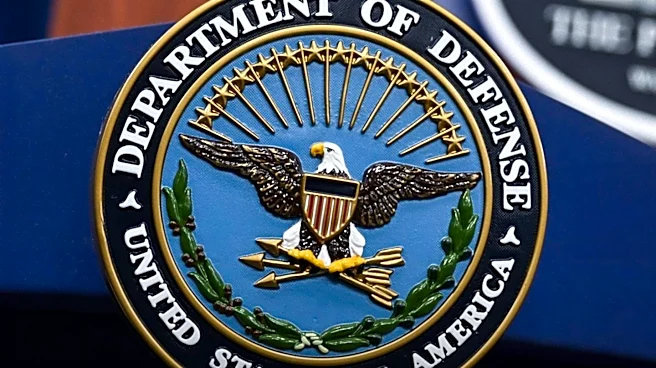
The Pentagon has officially renamed its Chief Digital and Artificial Intelligence Office (CDAO) to the 'Super Intelligence Office.' This change aligns with an executive order issued by President Trump in September, which mandated federal agencies to use
the term 'Super Intelligence' and its abbreviation 'SI' in official communications and non-statutory documents. Cameron Stanley continues to lead the office as Chief Super Intelligence Officer for the Department of War (DoW), with Andrew Mapes serving as Principal Deputy Super Intelligence Officer. The office's public resources, procurement information, and partnership portals have been migrated to the SI.mil domain. Existing programs, solicitations, and defense partnerships, including the Maven Smart System and the War Data Platform, will proceed without interruption. This rebranding signifies a shift beyond experimental prototypes, aiming to harness 'sovereign Super Intelligence' for decisive military superiority.
Why It's Important?
This rebranding within the Pentagon underscores a significant shift in how the U.S. government approaches and communicates about advanced technological capabilities, particularly in the defense sector. By adopting 'Super Intelligence,' the administration aims to project a more advanced and perhaps more assertive stance on its technological prowess. This move could influence public perception and international discourse surrounding AI, potentially setting a new standard for terminology in national security. For U.S. industries, particularly those involved in defense contracting and technology development, this change might signal a renewed focus and increased funding for projects aligned with 'Super Intelligence' initiatives. It also highlights the growing integration of advanced computing into military operations, impacting strategic planning and resource allocation. The emphasis on 'sovereign Super Intelligence' suggests a focus on domestically developed and controlled technologies, which could benefit U.S. tech companies and research institutions.
What's Next?
Following this renaming, federal agencies are expected to continue integrating the 'Super Intelligence' terminology into their official communications and operations, as directed by President Trump's executive order. The Department of War's Super Intelligence Office will likely intensify its efforts to develop and deploy advanced 'Super Intelligence' capabilities for military applications, potentially leading to new contracts and partnerships with private sector technology firms. The 'Super Intelligence Force,' a government-wide coordination group chaired by Director of National Intelligence Jay Clayton, will play a crucial role in harmonizing these efforts across various federal entities. Additionally, the Justice Department's Super Intelligence Task Force will continue its focus on civil and criminal enforcement related to 'Super Intelligence,' particularly concerning fraud and unlawful uses targeting critical infrastructure. This ongoing integration and enforcement will shape the future landscape of 'Super Intelligence' development and regulation in the U.S.
Beyond the Headlines
The rebranding of the Pentagon's AI office to the 'Super Intelligence Office' carries deeper implications beyond mere nomenclature. It reflects a strategic effort to frame advanced technological capabilities in a way that emphasizes national control and military dominance, potentially influencing geopolitical dynamics. The term 'Super Intelligence' might be perceived as a more powerful and less ambiguous descriptor than 'Artificial Intelligence,' signaling a commitment to achieving a superior technological edge. This linguistic shift could also impact public understanding and acceptance of these technologies, potentially fostering a sense of national pride or, conversely, raising concerns about the ethical and societal implications of such advanced systems. The focus on 'sovereign Super Intelligence' suggests a long-term strategy to reduce reliance on foreign technology and enhance national security through self-sufficiency in critical technological domains, potentially leading to increased domestic investment in research and development.