






What's Happening?
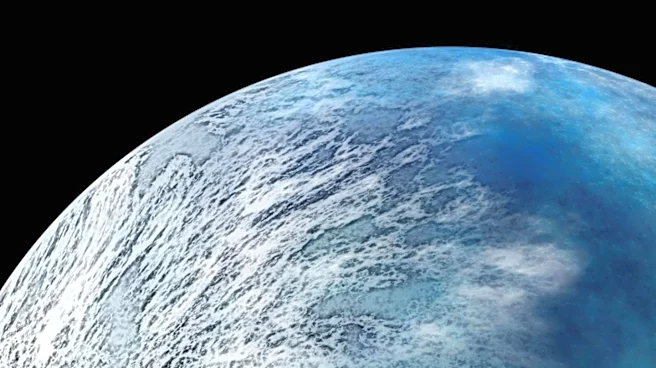
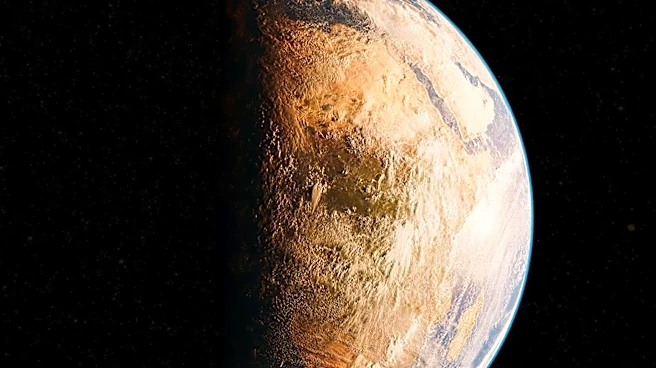
A 2025 study by Viktória Fröhlich and Zsolt Regály explores the potential for moons of rogue planets, expelled during supernova explosions, to maintain subsurface oceans. These moons, carried into deep space, could remain warm enough for liquid water
due to tidal heating, a process where gravitational forces cause internal heating. The study models scenarios where moons remain bound to their planets after a supernova, with some receiving sufficient tidal heating to sustain liquid water for billions of years. This research challenges the traditional view that life requires a star, suggesting that habitable conditions might exist in starless environments.
Why It's Important?
The study expands the understanding of potential habitats for life beyond the traditional star-centered model. If moons of rogue planets can sustain liquid water, it broadens the scope of astrobiological research and the search for extraterrestrial life. This could influence future space missions and the development of technologies to detect such environments. The findings also highlight the need for a broader definition of habitability, considering environments that do not rely on direct sunlight but on internal heating mechanisms.
Beyond the Headlines
The study's implications extend to the philosophical and scientific understanding of life in the universe. It challenges the assumption that life is confined to star-dependent systems, suggesting that life could exist in more diverse environments. This could lead to a paradigm shift in astrobiology and influence the criteria used to search for life beyond Earth. The research also underscores the importance of interdisciplinary approaches, combining astronomy, geology, and biology to explore new frontiers in the search for life.