





What's Happening?
Russia's Deputy Prime Minister Marat Khusnullin has proposed studying a new trade corridor to the Indian Ocean through Turkmenistan, Iran, Afghanistan, and Pakistan. This suggestion, made on August 9, has sparked discussions about its potential impact
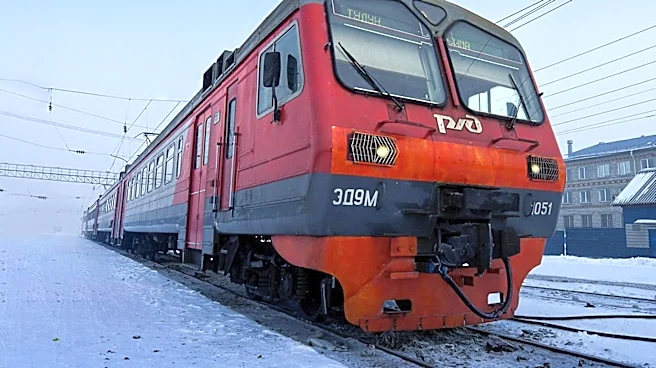
on existing Eurasian connectivity architectures, including China's Belt and Road Initiative (BRI). While some interpret this as a direct challenge to China's infrastructure dominance, analysis suggests it is more likely a hedge for India, aiming to diversify its trade routes rather than choosing a new patron. Much of the proposed route's infrastructure already exists, with Russia having shipped freight into Iran via Kazakhstan and Turkmenistan since 2014. However, significant challenges remain, including differing rail gauges between countries (Russia's broad, Iran's standard, India's broader still) and the absence of a continuous rail link. Pakistan's internal issues, such as closed borders with Afghanistan and India, further complicate its role as a potential linchpin for the railway. The proposal lacks concrete financing, route surveys, or treaties, and India has not yet publicly responded.
Why It's Important?
This proposed route is significant because it highlights the ongoing strategic competition for Eurasian connectivity and India's efforts to enhance its leverage in global trade. India's increasing dependence on Russian crude since 2022, with imports reaching 55.5% by July 2026, underscores a structural dependence that gives both nations leverage. For India, diversifying trade routes beyond existing options like the International North-South Transport Corridor (INSTC) and the India-Middle East-Europe Economic Corridor (IMEC) is a strategic move to create multiple options and reduce reliance on any single corridor or partner. This approach positions India to have Moscow, Washington, and Beijing compete for its engagement, strengthening its geopolitical standing. The proposal also sheds light on the complexities of regional stability, as the route traverses areas with ongoing conflicts and political sensitivities, such as Afghanistan and Pakistan. The lack of fresh Chinese capital committed to Pakistan's CPEC, despite rhetoric of a 'high-quality' revamp, suggests Beijing's caution and hedging against exposure to militant attacks, further opening avenues for alternative connectivity proposals.
What's Next?
The immediate next steps for this proposed Russian-India trade route are uncertain, given the lack of concrete financing, route surveys, or treaties. India's public response, or lack thereof, will be a key indicator of its interest. The feasibility of the route will depend on overcoming significant logistical challenges, including harmonizing rail gauges and addressing political instability in transit countries like Afghanistan and Pakistan. A critical development to watch would be an actual Pakistan-Afghanistan-India transit accord, which would signal serious progress. Alternatively, the idea could simply fade if sustained disruption in key waterways like the Strait of Hormuz does not materialize to force real investment into an Iran-India land link. It is also possible that Russia will continue to trade with both India and China through existing and overlapping networks, without the need for a new, dedicated railway. The ongoing war and unresolved Pakistan-Afghanistan hostility could also contribute to the proposal remaining on paper. Ultimately, India's strategy appears to be one of building a position with multiple, replaceable routes, rather than committing to a single patron.
Beyond the Headlines
Beyond the immediate logistical and political considerations, this proposal reflects a deeper trend of weaponized interdependence in global trade, where control of chokepoints, rather than military might, increasingly dictates trade flows. India's strategy of pursuing multiple connectivity architectures—Chabahar, IMEC, INSTC, and now potentially a Russian rail spur—demonstrates a calculated effort to build a position of strength where it is not beholden to any single power. This approach, described as a search for primacy without a single fixed anchor, allows India to hedge against geopolitical risks and maintain strategic autonomy. The proposal also highlights the evolving nature of alliances and partnerships, where economic interests and strategic positioning can lead to unexpected collaborations or competitive dynamics, even among ostensible allies. The challenges in Pakistan, including its inability to move goods across its own land borders, underscore the critical importance of internal stability and infrastructure capacity for any nation aspiring to be a linchpin in global trade routes. This complex interplay of economic necessity, geopolitical strategy, and regional instability will continue to shape the future of Eurasian connectivity.