





What's Happening?
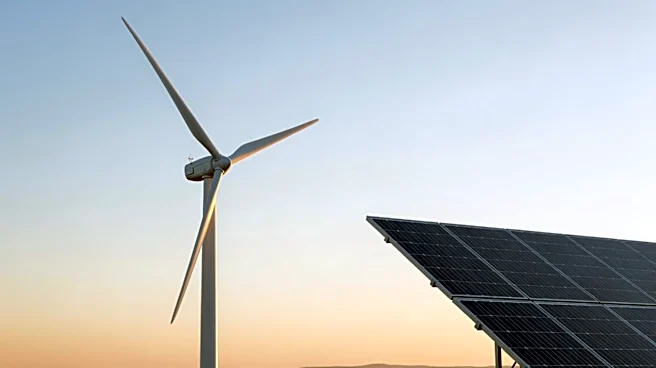
A report from CleanTechnica highlights the United States' lag in the global clean power buildout, despite having abundant resources and capabilities. The U.S. currently has about 380 GW of wind, water, and solar (WWS) capacity, significantly trailing
behind China and Europe. China leads with approximately 2,276 GW, while Europe has about 1,047 GW. The report attributes the U.S.'s position to issues such as policy coherence, transmission expansion, market design, and permitting friction. In contrast, India has made significant strides, adding 44.6 GW of solar in a single fiscal year, bringing its total WWS capacity to 257.8 GW. The report suggests that the U.S. needs to address these policy and infrastructure challenges to catch up with global leaders in renewable energy.
Why It's Important?
The U.S.'s lag in renewable energy development has significant implications for its economic and environmental future. As the world's largest economy, the U.S. has the potential to lead in the transition to clean energy, which could drive economic growth, reduce carbon emissions, and enhance energy security. However, the current lag suggests missed opportunities in these areas. The report underscores the need for coherent policies and infrastructure improvements to facilitate the expansion of renewable energy. By addressing these challenges, the U.S. could enhance its competitiveness in the global energy market and contribute to global efforts to combat climate change.
What's Next?
To improve its standing in the global clean power buildout, the U.S. may need to implement policy reforms that streamline permitting processes and enhance market design. Expanding transmission infrastructure and addressing political and economic barriers could also be crucial steps. These changes could enable the U.S. to leverage its resources more effectively and increase its renewable energy capacity. The report suggests that the U.S. should focus on building more WWS infrastructure per unit of GDP to align with global leaders and support a sustainable energy transition.