



What's Happening?
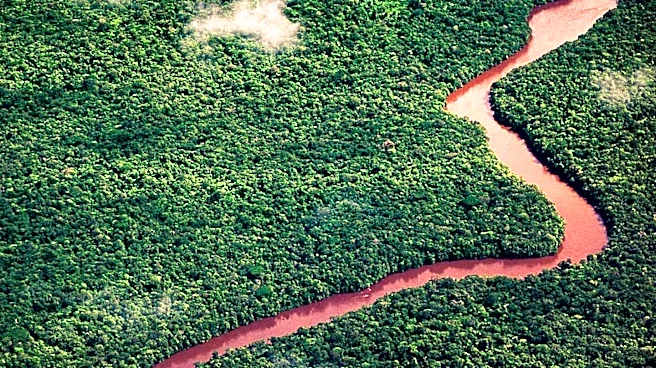
Researchers from São Paulo State University (UNESP) in Brazil are leading a study that uses water isotopes to monitor changes in Amazon rainfall. This method, which treats isotopes as a 'water fingerprint,' has revealed how phenomena like El Niño and
North Atlantic warming influence moisture origin and precipitation dynamics. The study, one of the first in over 30 years to apply isotopic techniques to Amazonian hydroclimatic research, has shown that the historic droughts of 2023 and 2024 in the Amazon significantly reduced river flows and altered rainfall composition. Daily monitoring in Manaus, the capital of the Brazilian state of Amazonas, provided crucial data. Rafaela Rodrigues Gomes, a geographer and doctoral candidate at UNESP, is the lead author of a paper published in Hydrological Processes, based on her master's thesis. Her advisor, geologist Didier Gastmans, coordinates UNESP’s Laboratory of Water Resources and Environmental Isotopes (LARHIA). The research indicates that different meteorological variables produce distinct isotope ratios, allowing scientists to trace water origins and predict drought conditions.
Why It's Important?
This research is important because it offers a potential early warning system for prolonged droughts in the Amazon, a region critical for global climate regulation. The Amazon rainforest plays a vital role in the global water cycle and carbon sequestration, and its health directly impacts weather patterns and biodiversity worldwide. Understanding and predicting droughts in this region can help mitigate their severe consequences, such as increased wildfires, ecosystem degradation, and disruptions to local communities and economies. The study's findings, which link isotopic changes to warmer and drier conditions, highlight the impact of climate change on the Amazon. For the U.S., changes in Amazonian climate can influence global weather systems, potentially affecting agricultural productivity, natural disaster frequency, and even long-term climate stability. The methodology developed by UNESP researchers could be adapted for other vulnerable regions globally, enhancing climate resilience and disaster preparedness.
What's Next?
Rafaela Rodrigues Gomes plans to expand her doctoral research, funded by the Coordination for the Improvement of Higher Education Personnel (CAPES), to study the influence of the Intertropical Convergence Zone (ITCZ) and other atmospheric processes on isotopes beyond Manaus. She is currently collecting rain samples from 19 stations across the Amazon and neighboring regions. This expanded network aims to better understand the origins of water vapor from the Atlantic that reaches the Amazon, recirculates through the forest, encounters the Andes, and contributes to rainfall in Brazil's Central-West, Southeast, and South regions, a phenomenon known as 'flying rivers.' The researchers emphasize the need for long-term observations, spanning 20 to 30 years, to confirm the recurrence of the isotopic signals as reliable early warning indicators. Continued funding and international collaboration will be crucial for establishing a robust and comprehensive monitoring network.
Beyond the Headlines
The deeper implications of this research extend to the broader understanding of climate change impacts and the development of advanced environmental monitoring technologies. The use of water isotopes provides a sophisticated tool for tracking hydrological cycles, offering insights that traditional meteorological methods might miss. This 'fingerprinting' technique can reveal subtle shifts in atmospheric moisture sources and precipitation patterns, which are critical for detecting early signs of climate stress. Ethically, this research underscores the urgent need for global cooperation in addressing climate change, as the Amazon's health has far-reaching consequences. Legally and culturally, the findings could inform policy decisions regarding land use, conservation efforts, and international agreements aimed at protecting rainforests. The long-term shift towards more frequent and intense droughts, as indicated by isotopic changes, highlights the increasing vulnerability of natural systems and the necessity for proactive adaptation strategies.