


What's Happening?
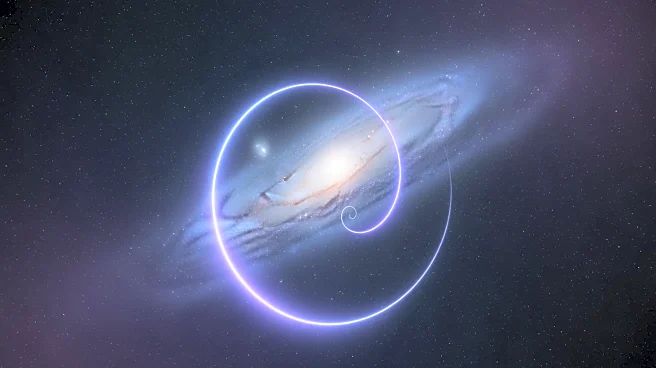
A group of amateur astronomers has discovered a mysterious arc of glowing gas near the Andromeda Galaxy, known as the Strottner-Drechsler-Sainty Object 1 (SDSO-1). The arc, which emits a faint glow from doubly ionized oxygen atoms, has sparked debate
among scientists regarding its origin. Some researchers propose that the arc is a 400,000-year-old aftershock from a planetary nebula, while others suggest it may be related to interactions between the haloes of sparse stars and gas surrounding the Andromeda and Milky Way galaxies. The discovery was made possible by advancements in digital detectors and optical filters, allowing amateur astronomers to capture deeper images than professional telescopes.
Why It's Important?
The discovery of SDSO-1 highlights the significant contributions amateur astronomers can make to the field of astronomy, especially with the aid of modern technology. This finding challenges existing theories about the interactions between galaxies and the remnants of dying stars. If the arc is indeed a planetary nebula, it could represent a new class of astronomical objects, termed 'ghost planetary nebulae.' This could provide new insights into the late-stage evolution of stars and their interactions with the interstellar medium. The ongoing debate among scientists underscores the complexity of cosmic phenomena and the need for further research to understand these mysterious structures.
What's Next?
Further observations and data collection are necessary to determine the true nature of SDSO-1. Scientists are expected to continue analyzing the arc's emissions and motions to confirm whether it is a planetary nebula or a result of galactic interactions. The discovery has also prompted researchers to search for similar objects, potentially leading to the identification of more ghost planetary nebulae. This could expand our understanding of stellar evolution and the dynamics of galaxy interactions. As more data becomes available, the scientific community will likely reach a consensus on the origin of this intriguing cosmic structure.