




What's Happening?
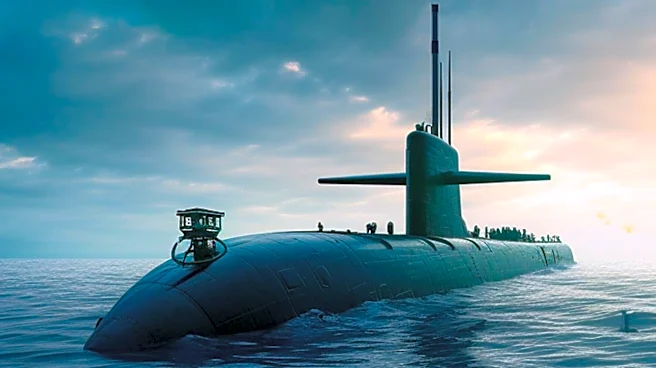
The U.S. Navy is initiating market research for its next-generation SSN(X) nuclear-powered attack submarine, seeking to assess domestic shipyard capacity for complex hull fabrication, modular outfitting, and nuclear reactor installation. This move comes
as the U.S. faces an intensifying challenge from China's rapid naval buildup and advancing undersea capabilities. The SSN(X) program aims to replace the aging Virginia-class fleet, with initial construction targeted around 2034. However, the U.S. Navy's current Virginia-class construction rates are lagging at 1.1 to 1.2 boats per year, significantly below the target of two hulls annually. This shortfall is attributed to systemic issues within the U.S. industrial base, including an uncompetitive duopoly between General Dynamics Electric Boat and Huntington Ingalls Industries, fragile supply chains, and a post-pandemic attrition of specialized machinists. Meanwhile, China's nuclear submarine production hub, Bohai Shipbuilding Heavy Industry Co., has surpassed the U.S. in total launches and combined tonnage between 2021 and 2025, achieving a sustained annual tempo of launching one Type-094 SSBN and two Type-093B SSGNs.
Why It's Important?
The widening gap in submarine production capacity between the U.S. and China poses a significant threat to U.S. naval supremacy and national security. U.S. submarines are critical assets for penetrating China's anti-access/area denial (A2/AD) envelope in potential conflicts, particularly over Taiwan. The delay in SSN(X) procurement and the underperformance in Virginia-class construction rates mean the U.S. may struggle to maintain its fleet numbers and technological edge against China's rapidly expanding and modernizing undersea force. This situation could alter the balance of power in critical maritime regions, impacting U.S. strategic interests and alliances. The challenges in the U.S. shipbuilding industrial base highlight broader issues of industrial capacity, workforce development, and supply chain resilience, which are crucial for maintaining a competitive defense posture. The potential for Russian technical assistance to China in acoustic stealth further complicates the U.S.'s long-standing advantage in submarine quietness.
What's Next?
The U.S. Navy's market research initiative will continue to gather data from prospective prime contractors to inform its acquisition strategy for the SSN(X) program. Addressing the systemic flaws in the U.S. shipbuilding industrial base will be critical, requiring significant investment in infrastructure, workforce training, and supply chain strengthening. Policy makers may need to consider measures to foster greater competition and innovation within the defense industrial sector. The U.S. will also likely continue to monitor China's advancements in submarine technology, including acoustic stealth, and adapt its own research and development efforts accordingly. The long-term success of the SSN(X) program and the maintenance of U.S. undersea supremacy will depend on a comprehensive strategy that not only focuses on next-generation technology but also on revitalizing the domestic shipbuilding capacity to meet current and future demands.
Beyond the Headlines
The competition in undersea warfare extends beyond military capabilities to encompass economic and technological rivalry. China's ability to rapidly scale up its shipbuilding capacity reflects a broader national industrial strategy that prioritizes state-backed development and supply chain control. This contrasts with the U.S. model, which relies more on private industry but faces challenges in maintaining a robust and competitive defense industrial base. The implications of this disparity could extend to other high-tech defense sectors, potentially eroding the U.S.'s overall technological advantage. Furthermore, the increasing sophistication of undersea warfare, including advancements in acoustic stealth and autonomous systems, raises complex questions about detection, deterrence, and the risk of miscalculation in a contested maritime environment. The long-term strategic stability in the Indo-Pacific region will be heavily influenced by how both the U.S. and China address these evolving undersea dynamics.