








What's Happening?
The Deputy Commander of United States Northern Command (NORTHCOM) issued a stark warning on August 13, stating unequivocally that the U.S. is currently unprepared to defend against a drone swarm attack within its own borders. When directly questioned
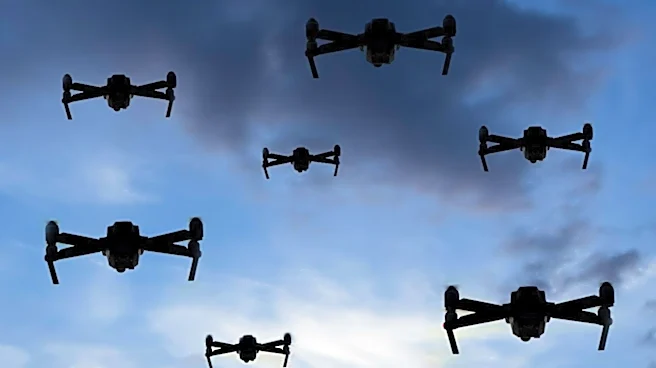
about the capability to counter such a threat, the official's response was described as "blunt and chilling: 'No.'" This admission highlights a significant and acknowledged vulnerability in the nation's homeland defense architecture. The context for this concern is the rapid advancement and proliferation of unmanned aerial vehicle (UAV) technology, particularly the development of coordinated drone swarms. These swarms, characterized by multiple drones operating autonomously or semi-autonomously to overwhelm defenses, represent a complex and evolving challenge for traditional air defense systems. The statement from a high-ranking military official underscores the urgency of addressing this gap, as the potential for adversaries to deploy such tactics against U.S. targets becomes increasingly feasible. The lack of preparedness suggests that current defensive measures and strategies may be insufficient to effectively neutralize a large-scale, coordinated aerial assault by numerous small, agile, and potentially difficult-to-detect drones. This revelation comes amidst global conflicts where drones are playing an increasingly decisive role, further emphasizing the critical nature of the threat.
Why It's Important?
This candid assessment from NORTHCOM's Deputy Commander carries profound implications for U.S. national security and defense policy. The acknowledged inability to defend against a drone swarm attack on the homeland represents a critical vulnerability that could be exploited by state adversaries or sophisticated non-state actors. Such an attack could target a wide array of critical assets, including vital infrastructure like power grids, transportation hubs, military installations, or densely populated civilian areas, leading to catastrophic economic disruption, significant casualties, and a severe erosion of public confidence in national defense capabilities. The statement serves as a powerful catalyst, signaling an urgent need for substantial investment in advanced counter-drone technologies, the rapid development of innovative defense strategies, and enhanced inter-agency coordination across federal, state, and local levels. This vulnerability could reshape defense spending priorities, accelerating research and development into areas such as artificial intelligence-driven defense networks, directed energy weapons, and sophisticated electronic warfare systems designed to detect, track, and neutralize multiple aerial threats simultaneously. Furthermore, it highlights the evolving nature of modern warfare, where relatively inexpensive and accessible technologies can pose existential threats to even the most technologically advanced nations.
What's Next?
The explicit acknowledgment of this critical vulnerability by a senior NORTHCOM official is expected to trigger immediate and intensified scrutiny from Congress, defense policymakers, and national security experts. This will likely lead to increased pressure on the Department of Defense to accelerate the development and deployment of robust counter-drone capabilities. Anticipated next steps include a potential surge in funding allocations for counter-UAS (Unmanned Aerial Systems) research and procurement, focusing on technologies capable of detecting, identifying, and neutralizing drone swarms. This could involve fast-tracking projects related to advanced radar systems, electronic jamming, cyber warfare defenses against drone control systems, and potentially kinetic interceptors. Furthermore, there will likely be a push for greater collaboration between military branches, intelligence agencies, and private sector innovators to rapidly acquire and integrate cutting-edge solutions. Expect to see an increase in large-scale military exercises and simulations specifically designed to test and refine defensive strategies against drone swarm scenarios, aiming to identify operational gaps and improve response protocols. The U.S. government may also explore international partnerships to share intelligence and develop common standards for counter-drone technologies, recognizing the global nature of this emerging threat.
Beyond the Headlines
The challenge posed by drone swarms extends far beyond immediate technological and strategic responses, delving into complex ethical, legal, and societal dimensions. The proliferation of both military and commercially available drone technology complicates the ability to distinguish between benign and hostile aerial objects, raising questions about surveillance, privacy, and the appropriate use of force within domestic airspace. This development underscores a fundamental shift in the character of warfare, where the advantage of conventional military superiority can be challenged by asymmetric threats leveraging relatively inexpensive, mass-produced systems. The potential for autonomous or semi-autonomous drone swarms also brings forth ethical dilemmas concerning human control in targeting decisions and the accountability for actions taken by AI-driven systems. Furthermore, the vulnerability highlights the need for a comprehensive national strategy that integrates not only military defense but also civilian preparedness, critical infrastructure protection, and public education on potential threats. This issue could also reignite debates about the balance between civil liberties and national security, particularly regarding expanded surveillance powers or restrictions on drone ownership and operation within the U.S.