

What's Happening?
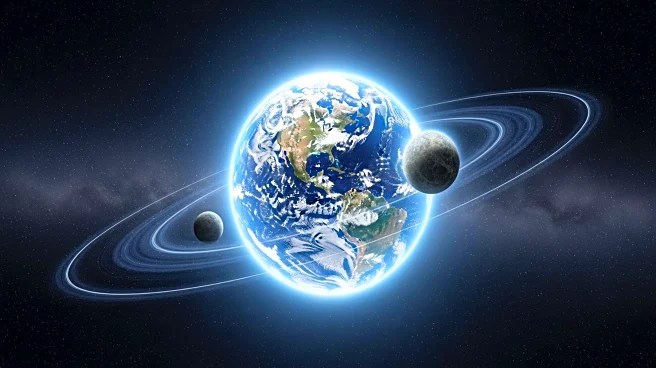
NASA has confirmed the existence of a quasi-moon, 2025 PN7, which has been orbiting near Earth for at least 70 years and will continue to do so for another 60 years. This object, however, is not a true moon as it orbits the Sun rather than Earth. The
discovery was first made by the Pan-STARRS observatory in Hawaii. Quasi-moons like 2025 PN7 are not gravitationally bound to Earth but maintain a close proximity due to their resonant orbit. The object has been described as a potential target for unmanned missions due to its accessibility.
Why It's Important?
The discovery of 2025 PN7 highlights the complexity of celestial bodies that interact with Earth. While not a true moon, its presence offers opportunities for scientific exploration and testing of planetary exploration technologies. Understanding such objects can provide insights into the dynamics of near-Earth objects and their potential impact on space missions. The classification of 2025 PN7 as a quasi-moon rather than a second moon clarifies misconceptions and emphasizes the need for precise scientific communication.
What's Next?
Further observations and studies of 2025 PN7 are likely to continue, focusing on its orbital dynamics and potential for future space missions. Scientists may explore the feasibility of using such quasi-moons for testing new technologies in space exploration. Additionally, the study of 2025 PN7 could contribute to broader research on near-Earth objects and their interactions with our planet.