



What's Happening?
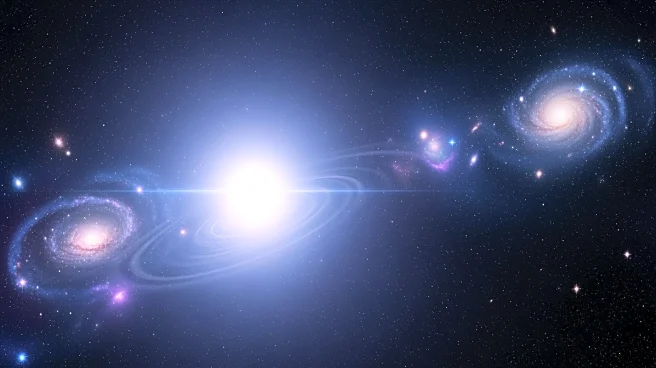
NASA has reported the disappearance of a massive star in the Fireworks Galaxy, NGC 6946, which flared to a brightness a million times that of the Sun before vanishing. The star, observed by the Hubble Space Telescope, is believed to have undergone a failed
supernova, collapsing into a black hole without the typical explosive end. This phenomenon, where a star's core collapses inward, leaving no visible remnants, provides valuable insights into the life cycle of massive stars and the formation of black holes. The event underscores the importance of long-term astronomical observations in understanding cosmic processes.
Why It's Important?
The quiet disappearance of the star challenges traditional notions of stellar death, where massive stars are expected to end in spectacular supernovae. This discovery has significant implications for astrophysics, particularly in understanding the conditions under which stars collapse into black holes. It also highlights the capabilities of the Hubble Space Telescope in capturing long-term changes in the universe, contributing to our knowledge of stellar evolution and the dynamics of galaxies. Such findings can refine theoretical models and enhance our understanding of gravitational forces and cosmic phenomena.
Beyond the Headlines
The event raises questions about the frequency of such silent collapses and their role in the cosmic landscape. It also prompts a reevaluation of how black holes form and the potential for similar occurrences in other galaxies. The integration of data from Hubble with newer telescopes like the James Webb Space Telescope could further illuminate these processes. Additionally, the discovery emphasizes the need for continued investment in space observation technologies to uncover the universe's hidden mysteries and advance our understanding of fundamental astrophysical principles.