






What's Happening?
A bill aimed at permanently banning Chinese connected vehicles from the U.S. market has cleared a Senate committee but faces a significant challenge due to an ownership-threshold clause. The proposed legislation, the Connected Vehicle Security Act of
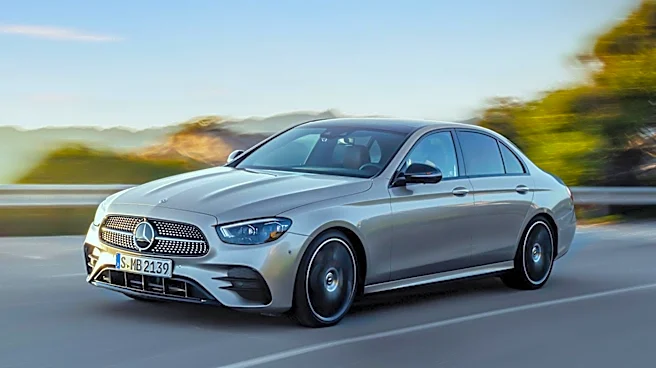
2026, would prohibit the sale, import, and manufacture of connected vehicles and related components from countries like China if more than 15% of the automaker is owned by entities linked to those nations. This threshold directly impacts Mercedes-Benz, a member of the Alliance for Automotive Innovation, as it has approximately 19.67% Chinese ownership through BAIC (9.98%) and Geely founder Li Shufu (9.69%). Lawmakers, including Senate Commerce Committee Chair Ted Cruz and Senator Bernie Moreno, have acknowledged this issue, stating that the provision would need to be amended before the bill can become law, as they do not intend to ban Mercedes-Benz.
Why It's Important?
This legislative development is crucial for the U.S. automotive industry and national security. The bill seeks to codify existing administrative bans on Chinese connected vehicles, making them more durable against future policy changes. The concern stems from the potential for connected vehicles to collect vast amounts of sensitive data, which, under China's National Intelligence Law of 2017, could be compelled for intelligence efforts. The current ownership threshold issue highlights the complex global supply chains and investment structures within the automotive sector. If passed as is, the bill could inadvertently penalize major automakers with significant U.S. presence and operations, potentially disrupting the market and impacting consumer choices. The debate also underscores the tension between national security concerns and economic realities, as lawmakers grapple with protecting data while avoiding unintended consequences for established businesses.
What's Next?
The immediate next step for the Connected Vehicle Security Act of 2026 is the revision of its ownership-threshold provision. Mercedes-Benz is actively lobbying to raise the cap to 25%, aligning it with thresholds for other covered entities. Lawmakers are also considering replacing the fixed percentage with a qualitative national security review. The bill must pass a full Senate floor vote, then the House, reconcile any differences, and be signed by the President before January 3, 2027. Failure to amend the provision could force Mercedes-Benz to restructure its ownership or seek waivers from the Commerce Department by 2030. The Alliance for Automotive Innovation is pushing for swift action before the current legislative session ends, aiming to secure a permanent statutory ban that addresses national security without unduly harming its members.
Beyond the Headlines
The situation with Mercedes-Benz reveals a deeper geopolitical strategy where Chinese state-linked capital has systematically acquired minority equity positions in Western legacy automakers. This strategy aims to gain access to technology, supply chains, and distribution networks, as seen with Volvo and Polestar. The bill's focus on ownership structure rather than just assembly location indicates a shift towards targeting control and data architecture, reflecting a growing awareness of the subtle ways foreign adversaries can influence critical technologies. The debate also highlights the structural nature of the threat, where China's laws could compel data collection regardless of a company's stated privacy policies. This legislative effort is part of a broader U.S. strategy to counter China's economic and technological influence, potentially setting precedents for how the U.S. regulates foreign investment and technology in other critical sectors.