





What's Happening?
Moldovan President Maia Sandu has stated that Russia may be intentionally sending drones into Moldova's airspace, citing drone trajectory patterns as evidence. These incursions are not isolated incidents, as similar violations have been reported in Romania
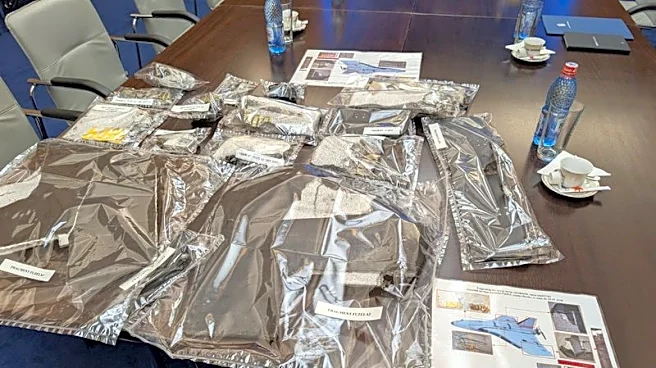
and Poland. Sandu emphasized that regardless of intent, these drones violate Moldovan airspace, and she holds the Russian Federation responsible for these actions, attributing them to the ongoing conflict initiated by Russia. She expressed skepticism that expelling Russia's ambassador, Oleg Ozerov, would alter Russia's behavior, noting that previous protest notes to Moscow have been ineffective. Sandu believes that Ukraine's success in the war is the most crucial factor in stopping these drone activities. Recent incidents include a Russian 'Banderol' loitering munition crashing in Moldova and a Shahed 138 (Geran-2) drone entering Moldovan airspace from Ukraine before being shot down over Romania by a Spanish F-18 fighter jet.
Why It's Important?
These repeated drone incursions into the airspace of Moldova, Romania, and Poland carry significant implications for regional stability and international relations. For Moldova, these incidents occur as the country pursues its EU accession bid, a process closely linked to Ukraine's path to membership. The violations raise concerns about Russia's potential to escalate the conflict beyond Ukraine's borders and test the response capabilities of NATO and EU member states along the eastern flank. U.S. intelligence suggests Russia might attempt limited attacks on allied countries, ranging from cyberattacks to covert operations. The deliberate nature of some incursions, as suggested by President Sandu, indicates a potential strategy by Russia to probe defenses and sow instability, which could necessitate a stronger, unified response from the international community and NATO allies, including the U.S., to deter further aggression and protect sovereign airspace.
What's Next?
The ongoing pattern of drone incursions suggests a continued need for heightened vigilance and defensive measures in the affected regions. Moldova, along with its allies, will likely continue to monitor its airspace closely and may explore further diplomatic or defensive actions. President Sandu's emphasis on Ukraine's success as key to stopping these drones indicates a continued focus on supporting Ukraine's war effort. This situation could lead to increased calls for stronger international sanctions against Russia and enhanced military aid to Ukraine. NATO and EU member states, including the U.S., may need to reassess their collective defense strategies and response protocols to these types of provocations. The potential for Russia to test NATO's resolve through limited attacks, as suggested by U.S. intelligence, means that future incidents could trigger more robust responses and further strain international relations.
Beyond the Headlines
The drone incursions highlight a broader strategy by Russia to exert pressure and destabilize neighboring countries, extending the reach of its conflict beyond direct military engagements. This 'hybrid warfare' approach, which includes airspace violations and potential testing of defenses, aims to create uncertainty and challenge the sovereignty of nations without necessarily initiating full-scale conflict. The Moldovan President's remarks about the ineffectiveness of protest notes underscore a deeper issue of international law and diplomatic norms being disregarded by Russia. This situation could lead to a re-evaluation of how international bodies and individual nations, including the U.S., respond to such persistent, low-level aggressions. It also brings into focus the ethical and legal dimensions of deliberate airspace violations, particularly when they involve potential military assets, and the long-term implications for regional security architecture and the principle of national sovereignty.