





What's Happening?
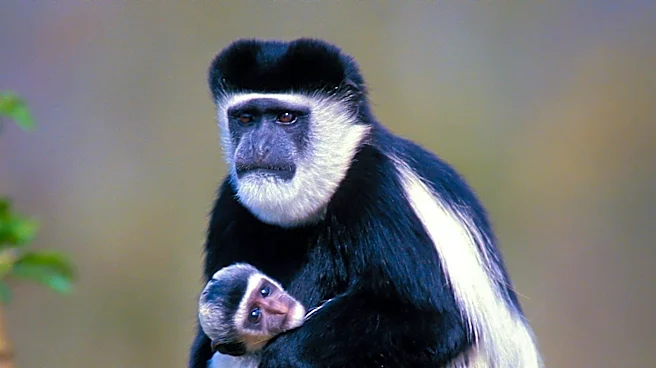
A new species of monkey, Colobus congoensis, locally known as 'Likweli,' has been formally identified in the Democratic Republic of Congo (DRC) after nearly two decades of observation and research. First photographed in 2008 and clearly seen in 2018,
genetic, anatomical, and acoustic evidence confirmed its distinct species status. This discovery marks only the fifth new monkey species identified in Africa in the past 75 years. The animal, weighing about 15 pounds, features a glossy black coat, an orange cream patch around its mouth and nose, and distinctive white markings. It inhabits a remote section of the Congo Basin between the Lomami and Congo (Lualaba) rivers. Researchers, including those from Florida Atlantic University and Yale University, published their findings in PLOS One. The species belongs to an evolutionary lineage that diverged from its closest known relative, Colobus satanas, approximately 4 to 5 million years ago, despite the latter being located over 1,200 kilometers away.
Why It's Important?
The discovery of Colobus congoensis highlights the significant biodiversity that still remains undocumented in the Central Congo Basin, reshaping understanding of primate evolution and conservation. Its unique evolutionary history, separating from its closest relative millions of years ago, underscores the region's role as a cradle of distinct species. However, the finding also comes with an urgent warning: the species is believed to be immediately endangered. Its exceptionally restricted range, estimated at only 1,700 square kilometers, coupled with ongoing threats from hunting and habitat loss, places it at high risk. This situation emphasizes the critical need for conservation efforts, particularly within Lomami National Park where most confirmed sightings occur, to protect newly identified species before they vanish. The involvement of U.S. institutions like Florida Atlantic University and Yale University in this international research underscores the global collaborative effort required for biodiversity discovery and preservation.
What's Next?
Researchers are proposing that Colobus congoensis be listed as Endangered on the IUCN Red List due to its limited distribution, small population, and persistent threats to its habitat. The focus will likely shift towards strengthening conservation measures within Lomami National Park and its surrounding buffer zones, which are crucial for the species' survival. Continued monitoring of the monkey's population and habitat will be essential to assess the effectiveness of these efforts. Further research may also explore the specific ecological roles of C. congoensis within its ecosystem and the precise impacts of human activities on its survival. The scientific community will also be looking for potential reactions from international conservation organizations and local governments to implement protective policies and allocate resources for the species' preservation.
Beyond the Headlines
The identification of Colobus congoensis underscores a broader ethical and scientific challenge: the race against time to discover and protect species before they disappear due to human impact. This discovery highlights the profound gaps in our understanding of global biodiversity, particularly in remote regions like the Congo Basin. It also brings to light the complex interplay between scientific exploration, local knowledge (as evidenced by the local name 'Likweli'), and conservation urgency. The long evolutionary separation of C. congoensis from its relatives suggests unique genetic adaptations that could hold valuable insights into primate biology and evolution. The immediate endangered status of a newly discovered species serves as a stark reminder of the accelerating rate of biodiversity loss and the critical need for proactive, rather than reactive, conservation strategies globally.