





What's Happening?
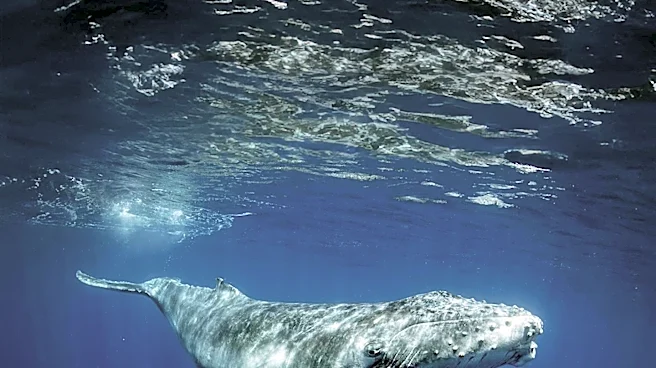
Researchers have discovered that subsea fiber-optic cables can detect whales even when they are silent. This breakthrough was made by Norwegian scientists who used distributed acoustic sensing (DAS) technology to monitor cetaceans. The study demonstrated
that the movement of a blue whale could be detected by the low-frequency waves it generated, which were picked up by the cables. This method offers a new way to study whale behavior and population density without relying on traditional hydrophones.
Why It's Important?
This development represents a significant advancement in marine biology and conservation efforts. By using existing subsea cables, researchers can monitor whale populations more effectively, providing crucial data for conservation strategies. This technology could help mitigate the impact of human activities on marine life, such as shipping and offshore construction. It also opens new avenues for studying marine ecosystems, potentially leading to better protection measures for endangered species.
Beyond the Headlines
The use of subsea cables for marine research also raises geopolitical and privacy concerns, as these cables are critical for global communications. The ability to detect large objects moving over these cables could have implications for national security and surveillance. Additionally, the technology's reliance on existing infrastructure highlights the need for collaboration between scientists and telecommunications companies to ensure access and data sharing.