


What's Happening?
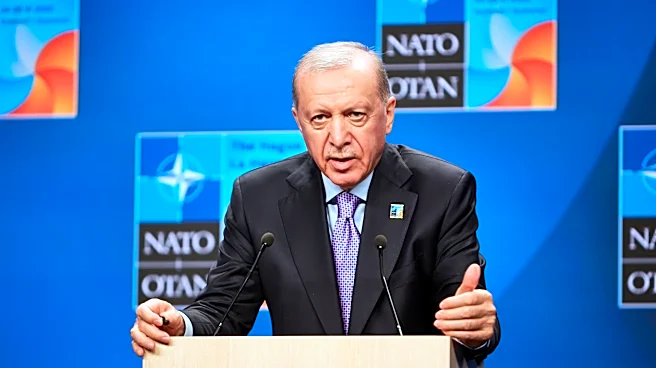
Turkish President Recep Tayyip Erdoğan stated on Wednesday that massacres, assassinations, starvation, and other atrocities are occurring daily in Gaza, which he described as 'the world’s largest concentration camp.' Speaking at a parliamentary group
meeting of his ruling Justice and Development (AK) Party in Ankara, Erdoğan accused Israel of these actions and warned of a significant humanitarian catastrophe as winter approaches, attributing it to Israel’s restrictions. He expressed deep concern for Palestinian children suffering in flooded and muddy conditions without adequate shelter. Erdoğan also criticized countries that claim to uphold democracy and human rights, highlighting what he called their exposed hypocrisy. He urged Muslim nations to take more decisive action to pressure Israel and deliver humanitarian aid to Gaza, emphasizing that Turkey would not remain silent in the face of oppression, even if it had to act alone. He also noted that the old world order is collapsing, leading to intense geopolitical competition, citing the Russia-Ukraine war and rising tensions in the Persian Gulf as examples.
Why It's Important?
President Erdoğan's strong condemnation of the situation in Gaza and his criticism of the international community's response carry significant weight due to Turkey's strategic position and its growing influence in the Middle East and the Muslim world. His remarks could further strain diplomatic relations with Israel and its allies, including the United States, potentially complicating regional peace efforts. By calling out the 'hypocrisy' of nations that champion democracy and human rights, Erdoğan challenges the moral authority of Western powers, which could resonate with populations in the Global South and lead to increased anti-Western sentiment. His appeal for greater action from Muslim countries could galvanize collective efforts to provide humanitarian aid and exert political pressure on Israel, potentially altering the dynamics of the conflict. The warning about a collapsing world order and intensifying geopolitical competition underscores a broader shift in global power structures, suggesting a more fragmented and volatile international landscape where traditional alliances are being re-evaluated.
What's Next?
Following President Erdoğan's statements, it is expected that Turkey will continue to advocate for increased humanitarian aid to Gaza and exert diplomatic pressure on Israel. Erdoğan's call for Muslim countries to take more action suggests potential for coordinated efforts among Islamic nations to address the crisis, possibly through OIC (Organisation of Islamic Cooperation) initiatives or bilateral engagements. Domestically, Erdoğan's strong stance on Gaza may bolster his political support among conservative and nationalist segments of the Turkish population. Internationally, his criticism of Western nations could lead to further diplomatic tensions, particularly with the United States and European Union members, who might view his rhetoric as inflammatory. The Turkish government may also explore new avenues for delivering aid, such as sending container homes, as winter conditions worsen in Gaza. The broader implications of a 'collapsing world order' suggest that Turkey will likely continue to pursue a more independent foreign policy, diversifying its alliances and seeking to enhance its regional influence.
Beyond the Headlines
The ongoing crisis in Gaza and President Erdoğan's vocal stance highlight deeper ethical and geopolitical implications. The accusation of Israel creating 'the world’s largest concentration camp' is a powerful and controversial rhetorical move that evokes historical atrocities, aiming to delegitimize Israel's actions and rally international opinion. This framing also challenges the narrative often presented by Western media and governments, forcing a re-evaluation of humanitarian responsibilities and international law. The criticism of 'hypocrisy' among self-proclaimed defenders of human rights points to a growing disillusionment with the selective application of international norms, particularly concerning conflicts in the Middle East. This sentiment could contribute to a broader shift in global alliances, with non-Western powers increasingly asserting their own moral and political frameworks. The call for Muslim nations to act independently reflects a desire for greater self-determination and collective agency within the Islamic world, potentially leading to new forms of regional cooperation and a rebalancing of global power dynamics away from traditional Western dominance.