





What's Happening?
Singapore has announced its decision to join an international agreement that observes and respects the permanent neutrality of the Panama Canal. This move was revealed by President Tharman Shanmugaratnam during Panamanian President Jose Raul Mulino's
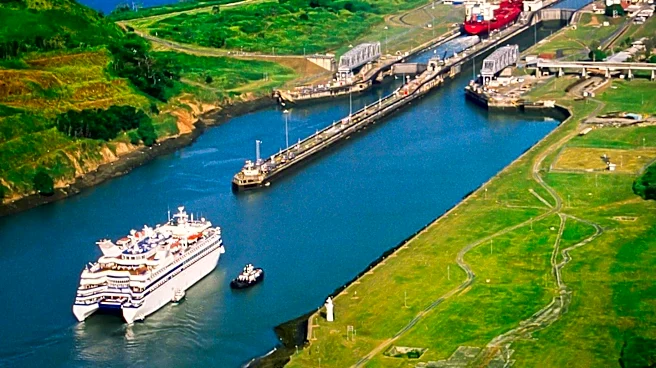
state visit to Singapore. The treaty, originally signed in 1977 by Panama and the U.S., establishes a regime of permanent neutrality, ensuring the waterway remains open for peaceful transit of vessels from all nations during both peace and war. Singapore's accession signifies its commitment to maritime safety, security, and upholding freedom of navigation through this critical global shipping lane. Additionally, both nations have agreed to negotiate a bilateral mutual legal assistance agreement to enhance cooperation in tackling transborder crime.
Why It's Important?
Singapore's decision to accede to the Panama Canal neutrality protocol is significant for global maritime trade and international law. The Panama Canal is one of the world's busiest shipping lanes, connecting the Pacific and Atlantic oceans, and its neutrality is crucial for uninterrupted global commerce. For the U.S., which previously controlled the waterway and remains a key stakeholder, Singapore's commitment reinforces the international consensus on the canal's status. This action supports the stability of global supply chains, which directly impacts U.S. businesses and consumers reliant on international shipping. Furthermore, the agreement to negotiate a mutual legal assistance treaty between Singapore and Panama will strengthen international efforts against organized crime, benefiting global security and trade integrity, including U.S. interests in combating illicit activities that could affect its borders or economic partners.
What's Next?
Singapore will proceed with the formal accession to the protocol concerning the permanent neutrality and operation of the Panama Canal. This process will involve diplomatic procedures to finalize its commitment to the international agreement. Concurrently, Singapore and Panama will begin negotiations on a bilateral mutual legal assistance treaty. This treaty aims to establish an enhanced framework for information sharing and legal cooperation, particularly in criminal investigations and proceedings. These steps are expected to further solidify the diplomatic and economic ties between the two nations, potentially leading to increased trade and investment opportunities. The enhanced legal cooperation could also set a precedent for similar agreements with other countries, contributing to a more robust international framework for combating transborder crime.
Beyond the Headlines
Singapore's decision to join the Panama Canal neutrality agreement, alongside its efforts to strengthen bilateral ties with Panama, reflects a broader strategic alignment among maritime nations. Both Singapore and Panama serve as critical junctions in global trade, and their shared interest in upholding freedom of navigation and international law is paramount in an increasingly complex geopolitical landscape. This move underscores the importance of multilateral cooperation in safeguarding vital global infrastructure against disruptions and strategic competition. It also highlights the evolving dynamics of international relations, where smaller states play a crucial role in reinforcing global norms and institutions. The emphasis on mutual legal assistance further illustrates a growing recognition of the interconnectedness of global security and economic stability, necessitating collaborative approaches to address transnational challenges.