
What's Happening?
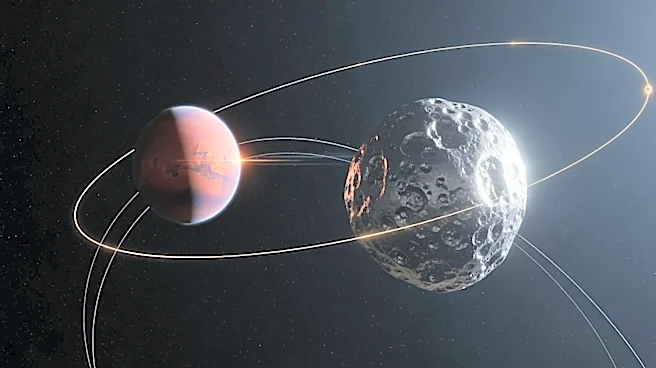
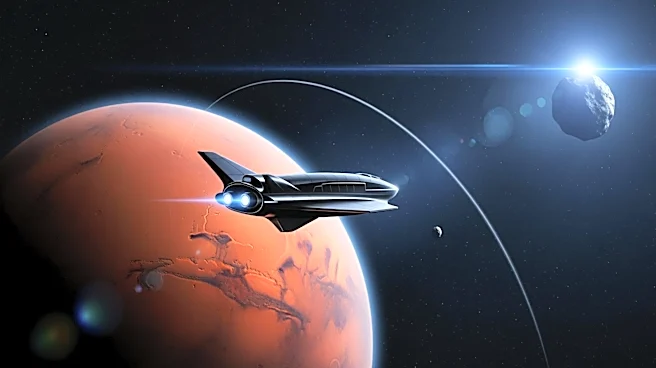
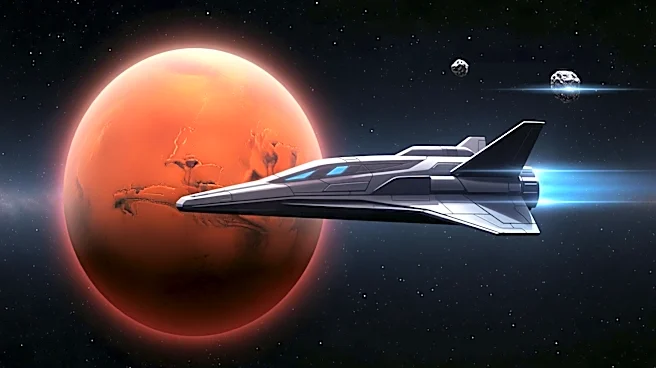
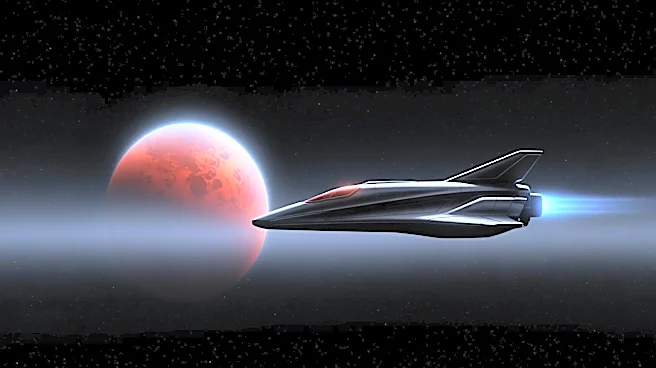
NASA's Psyche spacecraft recently executed a flyby of Mars, passing within approximately 2,800 miles of the planet. This maneuver was not intended to study Mars but to use the planet's gravity as a slingshot
to increase the spacecraft's speed and adjust its trajectory towards its ultimate destination, the metal-rich asteroid 16 Psyche. The flyby, which occurred on May 15, 2026, allowed the spacecraft to gain momentum by borrowing a small fraction of Mars' orbital energy, a technique known as a gravity assist. This method is crucial for conserving fuel and enabling the spacecraft to travel further and faster than it could with propulsion alone. The Psyche mission aims to reach the asteroid by 2029, where it will study what is believed to be the exposed metallic core of a protoplanet.
Why It's Important?
The Psyche mission represents a significant advancement in space exploration, particularly in understanding the building blocks of planetary formation. By studying the asteroid 16 Psyche, scientists hope to gain insights into the composition of planetary cores, which are typically inaccessible. The use of gravity assists, as demonstrated by the Mars flyby, highlights the innovative strategies employed in modern space missions to extend the reach of spacecraft while minimizing costs. This mission could provide valuable data that enhances our understanding of the solar system's history and the processes that shaped terrestrial planets, including Earth.
What's Next?
Following the successful Mars flyby, the Psyche spacecraft is now on course to reach the asteroid 16 Psyche by July 2029. The mission will involve detailed observations and analyses of the asteroid's surface and composition. The data collected could have implications for future space exploration and the potential for mining asteroids for resources. As the mission progresses, NASA will continue to monitor the spacecraft's trajectory and make any necessary adjustments to ensure it reaches its target. The success of this mission could pave the way for more ambitious explorations of the asteroid belt and beyond.