

What's Happening?
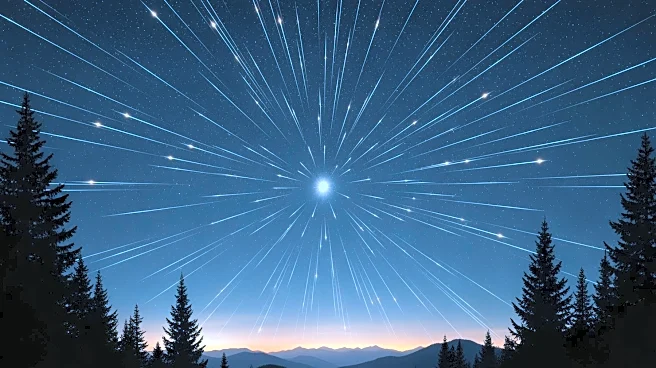
The annual Geminids meteor shower is set to peak on Saturday evening, offering a spectacular celestial display. According to NASA, the meteor shower will feature yellow streaks lighting up the night sky at a rate of 120 meteors per hour. This event is best
viewed from the Northern Hemisphere, although it will also be visible in the Southern Hemisphere. Unlike most meteor showers, which are caused by debris from comets, the Geminids originate from Asteroid 3200 Phaethon. This asteroid is a unique celestial body that scientists are still studying, as it may be a 'dead comet' or a 'rock comet.' To best view the meteor shower, NASA advises skywatchers to lie flat on their backs with their feet facing south and allow about 30 minutes for their eyes to adjust to the darkness.
Why It's Important?
The Geminids meteor shower is a significant astronomical event that draws the attention of both amateur and professional astronomers. It provides an opportunity for the public to engage with astronomy and appreciate the wonders of the night sky. The unique origin of the Geminids from an asteroid rather than a comet also presents a valuable research opportunity for scientists studying celestial bodies and their behaviors. Understanding the nature of Asteroid 3200 Phaethon could offer insights into the formation and evolution of our solar system. Additionally, such events can inspire interest in science and technology, potentially influencing educational and career pursuits in these fields.
What's Next?
As the Geminids meteor shower continues, scientists will likely conduct further observations and research to better understand Asteroid 3200 Phaethon and its characteristics. This could involve using telescopes and other observational tools to gather data on the asteroid's composition and behavior. Public interest in the meteor shower may also lead to increased participation in astronomy-related activities and events. Educational institutions and science organizations might use this opportunity to promote astronomy education and outreach programs, fostering a greater appreciation for space science among the general public.