



What's Happening?
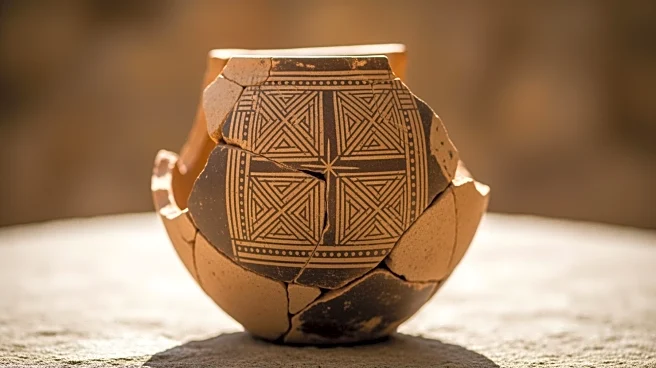
Researchers from the Hebrew University of Jerusalem have discovered that ancient pottery designs from the Halafian culture in northern Mesopotamia may represent some of the earliest evidence of mathematical reasoning. The pottery, dating back to between
6200 BC and 5500 BC, features floral motifs with petal counts that follow a geometric sequence, suggesting intentional mathematical thought. This discovery, published in the Journal of World Prehistory, indicates that the Halafians used a form of mathematical reasoning based on symmetry and repetition, possibly for practical purposes such as managing village resources.
Why It's Important?
This finding is significant as it provides insight into the cognitive development of early human societies. The use of mathematical reasoning in art suggests that the Halafians had a sophisticated understanding of symmetry and division, which could have been crucial for the organization and management of their communities. This discovery contributes to the field of ethnomathematics, highlighting how mathematical concepts were embedded in cultural expressions long before the advent of written records. It also challenges the traditional timeline of mathematical development, suggesting that such thinking emerged earlier than previously thought.
Beyond the Headlines
The study of Halafian pottery not only sheds light on early mathematical thought but also on the cultural and artistic practices of ancient societies. The emphasis on symmetry and aesthetics in their pottery designs reflects a cognitive shift towards appreciating the botanical world as a subject of artistic expression. This could indicate a broader cultural evolution towards more complex societal structures and interactions. Additionally, the research prompts a reevaluation of how mathematical knowledge is identified and understood in prehistoric contexts, potentially influencing future archaeological interpretations.