
What's Happening?
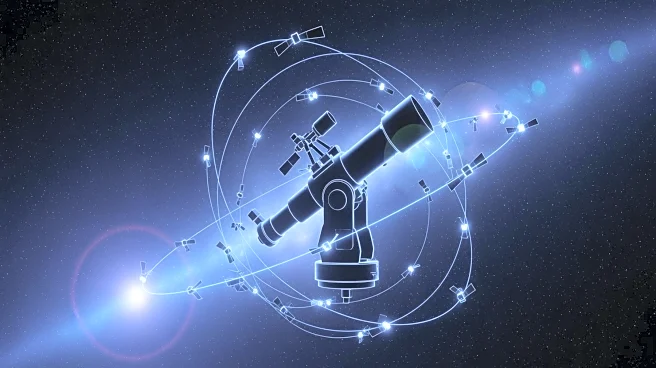
A recent study led by NASA highlights the growing threat posed by the increasing number of satellites in low-Earth orbit to space telescopes. The study, conducted by scientists at the NASA Ames Research
Center, reveals that the light reflected from these satellites can create bright streaks, known as satellite trails, which obscure cosmic images captured by telescopes like the Hubble Space Telescope. The research indicates that nearly one-third of Hubble's exposures are already affected by these trails. With the number of satellites expected to rise significantly, the study warns that up to 96% of images from some orbiting telescopes could be compromised. This issue is exacerbated by the rapid increase in satellite constellations, with projections suggesting that low-Earth orbit could host 560,000 satellites in the coming decade.
Why It's Important?
The findings of this study underscore a critical challenge for the field of astronomy and space exploration. As satellite networks expand, they pose a significant risk to the ability of space telescopes to conduct accurate observations of distant galaxies, planets, and other astronomical phenomena. This could hinder scientific research and the advancement of knowledge about the universe. The contamination of telescope images by satellite trails results in the permanent loss of valuable data, which cannot be recovered. This situation calls for urgent solutions to mitigate the impact of satellite interference on space-based observatories, ensuring that the scientific community can continue to explore and understand the cosmos effectively.
What's Next?
To address this growing issue, researchers and policymakers will need to explore potential solutions to coexist with the expanding satellite networks. This may involve developing new technologies or strategies to minimize the impact of satellite trails on telescope observations. Additionally, there may be discussions around regulating the deployment of satellites to balance the needs of communication networks with the preservation of space for scientific exploration. The study emphasizes the need for collaboration between space agencies, satellite operators, and the scientific community to find viable solutions that protect the integrity of astronomical research.
Beyond the Headlines
The increasing presence of satellites in low-Earth orbit raises broader questions about the management of space as a shared resource. The potential for satellite interference with space telescopes highlights the need for international cooperation and regulation to ensure that space remains accessible for scientific and commercial purposes. This situation also reflects the broader challenges of balancing technological advancement with environmental and scientific considerations, as the space industry continues to grow and evolve.