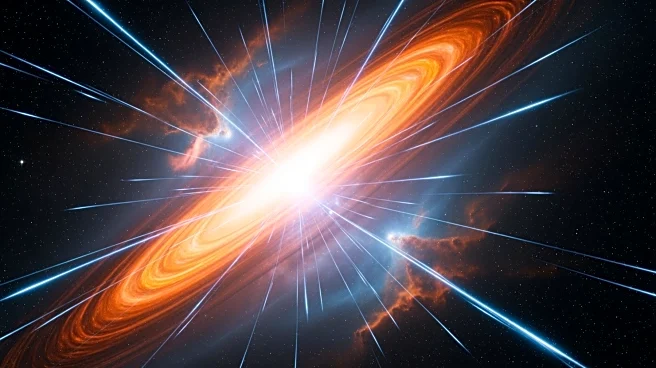




What's Happening?
Astronomers have utilized the Event Horizon Telescope (EHT) to trace a 3,000 light-year-long cosmic jet back to its origin, the supermassive black hole M87*. This black hole, located at the center of the galaxy Messier 87, was the first to be imaged by
humanity. The EHT's observations, particularly those from 2021, have allowed scientists to connect the glowing ring of material around M87* to the base of the jet, providing insights into the jet's origin. The study, led by Saurabh of the Max Planck Institute for Radio Astronomy, represents a significant step in understanding the mechanisms behind these powerful jets of charged particles. The findings could help unravel the mysteries of how such jets are launched and how they interact with their surrounding environments.
Why It's Important?
This discovery is crucial for advancing our understanding of supermassive black holes and their role in shaping the universe. The ability to trace the origin of cosmic jets back to their source provides valuable insights into the processes occurring near black holes. These jets can influence the formation and evolution of galaxies, affecting star formation and the distribution of matter. By understanding the mechanisms behind jet formation, scientists can better comprehend the dynamics of galaxies and the universe as a whole. This research also highlights the capabilities of the EHT and the potential for future discoveries in the field of astrophysics.
What's Next?
The research team plans to conduct further observations of M87* to gain a deeper understanding of the jet's structure and to capture more detailed images. These efforts aim to refine the current models of jet formation and to explore the interactions between supermassive black holes and their environments. Continued advancements in observational techniques and technology will likely lead to more breakthroughs in the study of black holes and their cosmic jets.