





What's Happening?
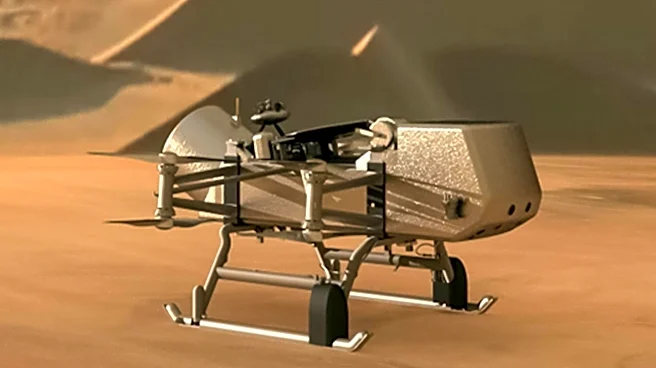
NASA is preparing for a groundbreaking mission with its Dragonfly rotorcraft, designed to explore Saturn's largest moon, Titan. Scheduled to launch no earlier than July 2028, Dragonfly is expected to arrive at Titan by late 2034. This mission marks the
first time a rotorcraft will be used to explore another world, leveraging Titan's dense atmosphere and low gravity to travel between multiple landing sites over a planned three-year period. The octocopter will study Titan's geology, meteorology, and complex chemistry, flying miles across its surface to collect samples for scientific analysis. Unlike previous missions that were confined to small areas, Dragonfly will explore diverse regions such as dunes and the Selk Crater. According to Dr. Elizabeth Turtle, a planetary scientist at the Johns Hopkins Applied Physics Laboratory, the mission aims to investigate the chemistry that preceded biological life on Earth.
Why It's Important?
The Dragonfly mission represents a significant advancement in planetary exploration, potentially transforming our understanding of extraterrestrial environments. By utilizing aviation technology in a novel way, NASA is pushing the boundaries of what is possible beyond Earth. This mission could provide insights into the chemical processes that may have led to the development of life, offering clues about the origins of life on Earth and the potential for life elsewhere in the universe. The success of Dragonfly could pave the way for future missions to other celestial bodies, expanding the scope of scientific inquiry and technological innovation in space exploration.
What's Next?
As the launch date approaches, NASA will continue to refine the technology and mission parameters to ensure the success of Dragonfly. The mission's progress will be closely monitored by the scientific community, with potential implications for future exploration strategies. Stakeholders, including planetary scientists and aerospace engineers, will be keenly interested in the outcomes of Dragonfly's flights and the data collected from Titan's surface. The findings could influence the design and objectives of subsequent missions to other moons and planets, furthering humanity's quest to understand the cosmos.
Beyond the Headlines
Dragonfly's mission to Titan not only challenges the limits of aviation technology but also raises questions about the ethical and philosophical implications of exploring other worlds. As humanity extends its reach into the solar system, considerations about the preservation of extraterrestrial environments and the potential impact of human activity become increasingly relevant. The mission underscores the importance of responsible exploration and the need to balance scientific curiosity with environmental stewardship.