



What's Happening?
A new report from the consumer advocacy group Public Citizen indicates that President Trump's second administration has appointed significantly more ultra-wealthy individuals than the three preceding presidencies combined. The report, published on Monday,
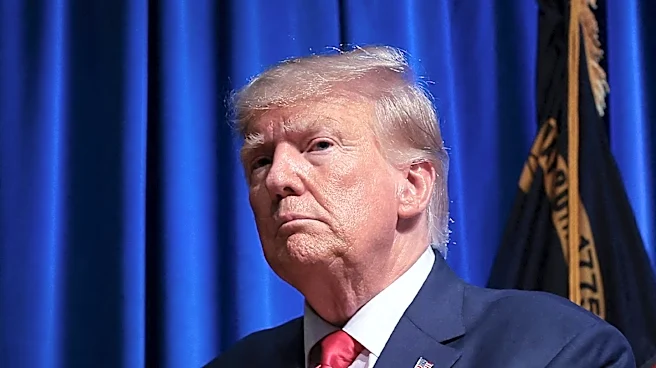
identifies 57 Trump officials with a net worth of at least $100 million. This figure includes 17 ambassadors and 40 individuals in senior executive branch positions. Notably, eight of the 23 Cabinet members meet this criterion, including Commerce Secretary Howard Lutnick and Education Secretary Linda McMahon, both billionaires. By contrast, the administrations of Republican George W. Bush and Democrat Joe Biden each had five officials worth $100 million or more, while Democrat Barack Obama's administration had three. President Trump, himself a billionaire, has often justified his appointments of wealthy individuals by citing their financial success and perceived competence.
Why It's Important?
The significant concentration of ultra-wealthy individuals in President Trump's administration raises critical questions about potential conflicts of interest and the representation of diverse economic perspectives within the U.S. government. Public Citizen's co-president, Lisa Gilbert, highlighted concerns that a government overwhelmingly populated by the economic elite could lead to 'misplaced incentives and corruption,' questioning whose interests these officials truly serve. This trend could influence policy-making, potentially favoring the interests of the wealthy and corporate sectors over those of middle-income and working-class Americans. While presidents have historically appointed wealthy individuals to high-profile roles, the sheer scale under President Trump's administration is unprecedented, potentially exacerbating economic inequality and fostering a perception that government is less responsive to the needs of the general populace. This dynamic is particularly relevant as President Trump faces a midterm election electorate less satisfied with his handling of the economy.
What's Next?
The Public Citizen report is likely to fuel ongoing debates about wealth, influence, and governance in the United States. Advocacy groups and political opponents may use these findings to scrutinize the administration's policies and appointments, particularly concerning economic regulations, tax cuts, and social programs. The report could also prompt discussions about the ethical implications of appointing individuals with vast personal wealth to positions of public trust, and whether existing disclosure and ethics rules are sufficient to prevent conflicts of interest. As the midterm elections approach, the composition of the administration could become a campaign issue, with candidates emphasizing the need for a government that better reflects the economic diversity of the country. This could lead to calls for reforms in appointment processes or stricter financial transparency requirements for public officials, aiming to ensure that government decisions are made in the broader public interest.
Beyond the Headlines
The phenomenon of a government heavily populated by the ultra-wealthy extends beyond immediate policy concerns to touch upon fundamental aspects of democratic representation and social contract. When a significant portion of government leadership comes from a narrow economic stratum, it can create a disconnect between the governed and the governors, potentially undermining the principle of a government 'of the people, by the people, for the people.' This concentration of wealth in power could subtly shift societal values, normalizing extreme wealth as a prerequisite for leadership and potentially diminishing the perceived value of public service driven by non-financial motivations. It also raises questions about the 'revolving door' between government and industry, where policies enacted by wealthy officials could directly benefit their former or future business interests. The long-term impact could be a further entrenchment of economic power within political structures, challenging the ideal of a meritocratic and equitable society.