
What's Happening?
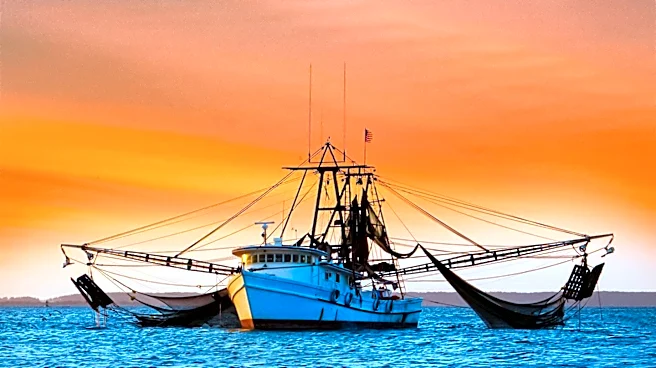
U.S. Senator Cindy Hyde-Smith (R-Miss.) has drawn attention to the U.S. Department of Agriculture's (USDA) decision to acquire up to $20 million in surplus wild-caught shrimp products. These products are
slated for distribution to schools and food banks across the nation. The purchase is being executed through the Section 32 Program, a standing initiative that enables the USDA to buy excess U.S. agricultural commodities for domestic food and nutrition assistance programs. This specific acquisition of wild-caught shrimp was announced in late August as part of a larger $156 million Section 32 purchase of domestic agricultural goods. Senator Hyde-Smith has consistently advocated for Section 32 purchases of Mississippi commodities, including a recent successful push for the USDA to purchase $20 million worth of farm-raised catfish in July.
Why It's Important?
This USDA purchase is significant for the U.S. shrimp industry, offering much-needed relief to producers facing intense foreign competition. By buying surplus domestic shrimp, the program helps stabilize the market for U.S. shrimpers, who work to supply safe and nutritious products. Simultaneously, the distribution of these shrimp to schools and food banks addresses critical food security and nutrition needs nationwide, providing healthy protein sources to vulnerable populations. Senator Hyde-Smith's advocacy underscores the economic challenges faced by domestic seafood producers and highlights the role of federal programs in supporting these industries while also benefiting public welfare through food assistance. The initiative also reinforces the importance of domestic food production and its connection to national nutrition programs.
What's Next?
Senator Hyde-Smith continues to champion legislative efforts aimed at protecting and supporting the U.S. seafood industry. She has introduced the Save Our Shrimpers Act (S.4805), which seeks to prevent federal funds from being used by international financial institutions to finance foreign shrimp activities. Additionally, her Safer Shrimp Imports Act (S.667) proposes requiring overseas shrimp facilities to undergo inspections and mandates that foreign countries exporting shrimp to the U.S. meet food safety standards equivalent to those of U.S. producers. Furthermore, an amendment based on her Let Americans Buy with Explicit Labeling (LABEL) Act (S.3065), which would ensure clear country of origin and production method labeling for all seafood, was recently adopted by the Senate Agriculture Committee for a pending new Farm Bill. These legislative initiatives indicate a continued focus on ensuring fair competition and safety standards for domestic seafood.
Beyond the Headlines
The broader implications of these actions extend to national food security, international trade relations, and consumer confidence in seafood products. The push for stricter import standards and country-of-origin labeling reflects growing concerns about the quality and safety of imported food, as well as the economic impact of foreign competition on domestic industries. By supporting U.S. shrimpers and catfish farmers, the government is not only providing economic relief but also reinforcing the value of local food systems. The legislative efforts highlight a strategic move to level the playing field for U.S. producers, potentially influencing future trade policies and consumer purchasing habits. This also raises ethical considerations regarding the environmental and labor practices in foreign shrimp production, which U.S. legislation aims to address indirectly by promoting domestic standards.